
If you’ve done any research into hair transplants, you’ve landed on this comparison. It’s the first real decision most patients face once they’ve decided surgery is the direction they’re heading, and the amount of conflicting information available makes it genuinely harder than it should be.
Most articles on FUE vs FUT are written by clinics that specialize in one or the other. The FUE clinics tell you FUT is outdated and scarring. The FUT surgeons tell you FUE damages more grafts. Neither is giving you the full picture because neither has a financial interest in doing so.
This guide is the comparison that doesn’t start with a conclusion. Both techniques work. Both produce results that can be exceptional in the right hands for the right patient. The question isn’t which technique is better; it’s which technique is better for your specific case. By the end of this article you’ll know the answer.
FUE vs FUT Which is Better?
Before the comparison, a quick orientation on what the techniques actually are because the decision only makes sense once you understand what you’re deciding.
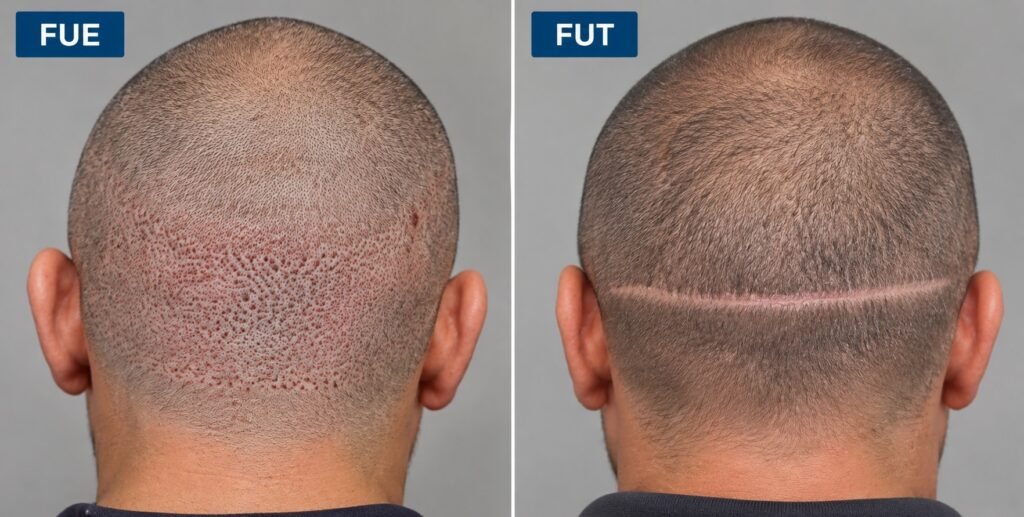
FUE (Follicular Unit Extraction) harvests individual hair follicles one at a time from the donor area using a tiny circular punch tool. Each follicle is extracted individually, leaving a small circular mark that heals invisibly at normal hair lengths. No linear scar. Faster recovery.
FUT (Follicular Unit Transplantation) harvests a strip of scalp from the donor area, dissects it under microscopes into individual follicular units, and closes the wound with sutures. It leaves a linear scar across the back of the head. Can yield a higher graft count per session.
Once the grafts are harvested by either method, they are implanted in exactly the same way into the recipient area. The techniques diverge entirely at the harvesting stage. Everything that happens afterward is identical.
This is worth stating clearly: for equivalent graft counts and surgical quality, FUE and FUT produce the same transplanted result. The growth timeline is the same. The density is comparable. The final appearance in the recipient zone is the same. The technique affects your donor area, your recovery, your future flexibility, and your cost, not the outcome in the thinning areas you’re trying to restore.
The Core Trade-Off in One Sentence
FUE gives you no linear scar and easier recovery in exchange for a lower per-session graft ceiling and higher cost.
FUT gives you higher graft counts per session and a lower cost, in exchange for a linear scar and a more involved recovery.
Everything else in this article is detailed around that core trade-off.
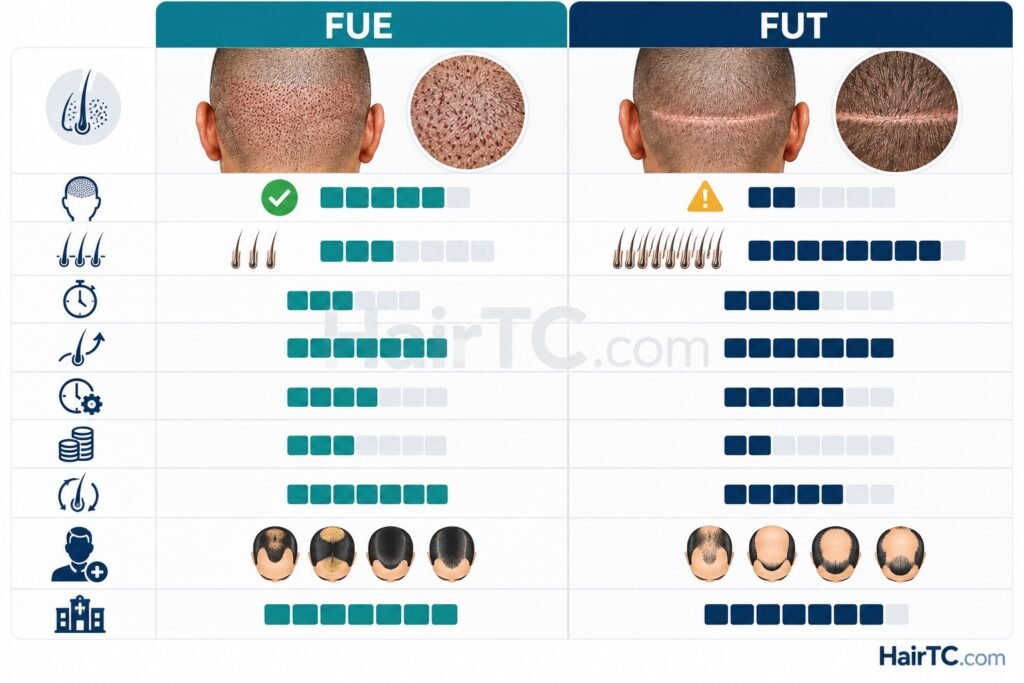
FUE vs FUT Comparison: Every Variable That Matters
1. Donor Scarring
FUE: Hundreds to thousands of tiny circular scars, 0.6mm to 1.0mm in diameter, distributed across the donor zone. At normal hair lengths, anything above a grade 2 or 3 clipper cut is completely invisible. Even at very short lengths, they appear as subtle white dots rather than an obvious scar pattern. At shaved-to-skin level, they are visible under close inspection.
FUT: A single linear scar running horizontally across the back of the scalp, typically between 15cm and 30cm long. Width depends heavily on closure technique and surgeon skill. A well-executed trichophytic closure leaves a scar of 1mm to 2mm that is invisible at hair lengths of approximately half an inch. A poorly executed closure can leave a widened, stretched scar that requires two inches or more of hair to conceal.
Verdict: FUE wins for scar profile at all hair lengths. FUT’s scar is manageable but permanent, and its visibility is technique-dependent in ways that FUE’s micro-scars are not.
2. Short Hair and Hairstyle Flexibility
FUE: Grade 1 or 2 clipper cuts at the back and sides are fine. Shaved head is fine. Military-style cuts are fine. The tiny circular marks at short lengths are subtle enough that most people, including hairdressers, don’t notice them without specifically looking.
FUT: Grade 1 or 2 cuts at the back will reveal the scar. Skin-shaved will make it prominently visible. Patients who wear or want to wear the back of their hair very short are not good FUT candidates, full stop.
Verdict: FUE wins decisively for patients who wear or might ever want to wear short hair at the back. For patients who confidently wear half an inch or longer at the back permanently, FUT is workable.
3. Graft Count Per Session
FUE: Most experienced surgeons cap single-session FUE at 3,000 to 4,000 grafts to avoid depleting the donor area visibly. Very large FUE sessions 4,000 to 5,000 grafts are sometimes performed over two consecutive days but require careful donor management.
FUT: A single strip from a patient with good scalp laxity can yield 3,000 to 5,000 or more grafts in one session, harvesting from a comparatively smaller surface area of the donor zone. For patients with extensive hair loss Norwood 5, 6, or 7 patterns who want maximum coverage in one procedure, FUT’s higher per-session yield can be clinically meaningful.
Verdict: FUT wins for raw single-session graft count, particularly for patients with extensive loss. For patients needing 3,500 grafts or fewer, both techniques are comparable.
4. Graft Survival Rate
FUE: The punch extraction process is technically demanding. Transection rates the percentage of grafts accidentally damaged during extraction range from 3 to 8 percent at experienced practices and above 15 percent at less skilled operations. The brief period grafts spend outside the body between extraction and implantation is a survival variable managed through holding solutions and workflow organization.
FUT: Strip-harvested grafts are dissected from the surrounding tissue with their structure largely intact, making them slightly more robust at the point of implantation. Studies comparing the two techniques typically find 3 to 8 percent better graft survival with FUT. In practice, at experienced FUE practices with low transection rates and efficient workflows, the practical difference narrows significantly.
Verdict: FUT has a marginal biological advantage in graft survival. At skilled practices, the difference in final density is small but real for a 3,000-graft procedure, it might mean 90 to 240 more surviving grafts.
5. Recovery
FUE: Donor area soreness for three to five days. No sutures. Most patients return to desk work within three to five days. Full activity clearance exercise, swimming at four to six weeks. The donor area looks essentially normal within ten to fourteen days once small scabs resolve.
FUT: Sutures in the donor area for ten to fourteen days. The wound feels tight and tender during healing. Most patients are comfortable returning to desk work after seven to ten days. Strenuous activity and anything that stretches the donor closure site should wait three to four weeks. The donor area takes longer to feel normal.
Verdict: FUE recovery is faster, more comfortable, and involves fewer restrictions. For patients who can’t take extended time off or who lead physically active lives, FUE’s recovery advantage is practically meaningful.
6. Procedure Length
FUE: Longer for equivalent graft counts, because individual punch extraction is more time-intensive than strip harvest. A 3,000-graft FUE procedure typically runs nine to twelve hours. Very large sessions may require two days.
FUT: The strip harvest takes fifteen to thirty minutes regardless of graft count. A 3,000-graft FUT procedure total time including dissection and implantation typically runs six to nine hours.
Verdict: FUT is faster for equivalent graft counts. Not a clinically significant difference for most patients, but worth knowing.
7. Cost
FUE: Priced at a 10 to 20 percent premium over FUT at clinics that offer both, reflecting the longer extraction process and the per-graft labor investment.
In the US, a 3,000-graft FUE procedure at a mid-tier practice: $9,000 to $16,000. In Turkey (all-inclusive): €2,500 to €4,000 (~$2,750 to $4,400).
FUT: Typically 10 to 20 percent lower than FUE at equivalent quality clinics. In the US, 3,000-graft FUT: $7,000 to $13,000. In Turkey (where FUT is less commonly offered): €2,000 to €3,500 (~$2,200 to $3,850) where available.
Verdict: FUT offers a real but modest cost advantage. The absolute saving on a mid-range procedure is typically $1,000 to $3,000 in the US market.
8. Long-Term Donor Flexibility
FUE: Extractions are distributed across the entire safe donor zone. Future sessions can draw from different areas within that zone. The donor area retains a more natural appearance even after multiple sessions because depletion is spread rather than concentrated.
FUT: Each strip reduces scalp laxity. Multiple FUT sessions progressively limit future strip harvesting most scalps support two, sometimes three FUT sessions before laxity is exhausted. The linear scar also complicates FUE harvesting in the same strip zone, though FUE can be performed in untouched zones above and below.
Verdict: FUE offers better long-term flexibility, especially for younger patients with progressive loss who are likely to need more than one procedure in their lifetime.
9. Hair Texture Considerations
FUE: Works best with straight to moderately wavy hair. Tightly coiled, Afro-textured hair presents a specific challenge the follicle curves beneath the scalp surface, making punch extraction more prone to transection. Skilled FUE surgeons who specialize in textured hair exist, but they are fewer than generalist FUE practitioners.
FUT: Strip dissection under microscope allows the technician team to visually track curved follicles through the tissue, resulting in lower transection rates for tightly coiled hair. For patients with Afro-textured or very tightly coiled hair, FUT is sometimes the technically superior choice and worth discussing specifically with any surgeon you consult.
Verdict: FUT has an advantage for tightly coiled hair types. For all other hair textures, the difference is minimal at experienced practices.
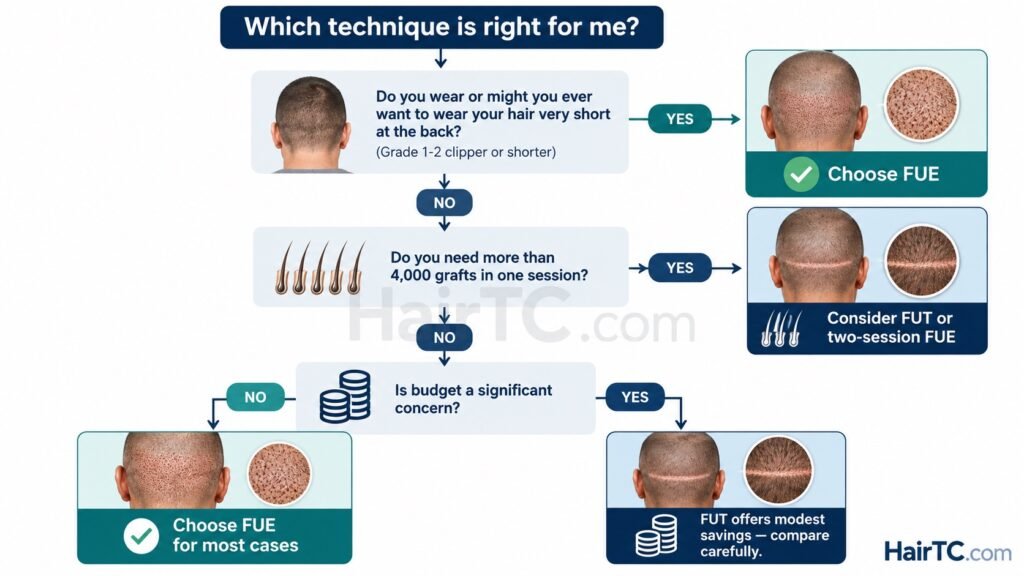
A Visual Decision Framework
Here’s the most direct possible summary of who should choose what.
Who Should Choose FUE
FUE is the right default for the majority of hair transplant patients in 2026. Here’s the specific profile:
You wear short hair at the back, or might want to in the future. This is the most important single criterion. If there’s any possibility you’ll ever want a short back-and-sides, FUE is the only rational choice.
You’re under 40 with ongoing hair loss. Younger patients are more likely to need future procedures as their hair loss progresses. FUE’s superior donor flexibility makes it the strategic choice for patients who will likely return to the chair in five to ten years.
You value faster recovery. If you can’t take two weeks off work, if you’re physically active, or if the idea of sutures in your scalp for ten days is unappealing, FUE’s recovery profile is meaningfully better.
You need 3,500 grafts or fewer. For the majority of first-time patients, the required graft count falls within FUE’s comfortable per-session range. The higher graft ceiling of FUT is only relevant for patients with extensive loss.
You have straight to moderately wavy hair. FUE works best with straight and wavy hair textures, which represents most patients in the US and European markets.
You want the most widely available expertise. The pool of highly experienced FUE surgeons globally is larger than the FUT pool, simply because FUE has been the dominant technique for a decade. Finding an excellent FUE practitioner is statistically easier.
Who Should Choose FUT
FUT has a narrower but genuine target patient profile. If you fit this profile, the conversation with your surgeon about FUT is worth having seriously rather than dismissing it based on headlines.
You are certain you will always wear your hair half an inch or longer at the back. This is the foundational criterion. If your lifestyle, profession, and aesthetic preferences mean you will never wear the back of your hair shorter than half an inch, the FUT scar is a non-issue at its best-case execution.
You need a very high graft count 4,000 or more and prefer one session. If your loss pattern requires 4,500 grafts and you want to address it in a single procedure, FUT’s strip yield makes this more achievable without concerning the donor zone. A two-session FUE approach is an alternative, but not everyone wants to go through the procedure and recovery twice.
You have tightly coiled or Afro-textured hair. As covered above, FUT’s strip dissection under microscope produces lower transection rates for curved follicle profiles. This is a genuinely technique-specific advantage worth discussing with your surgeon if your hair texture is tightly coiled.
Cost is a significant factor. If the $1,500 to $3,000 cost difference between equivalent FUE and FUT in the US market is meaningful to your budget and you accept the scar trade-off, FUT is a rational value choice.
You are having a revision FUT session with remaining laxity. If you had a previous FUT session that achieved good results and you have sufficient remaining scalp laxity for a second strip, a follow-up FUT session can be the most efficient way to harvest additional grafts for a second procedure.
The Cases Where Either Works And How to Decide
For patients who fall between the clear profiles moderate loss, comfortable with either hairstyle, budget not a constraint the decision comes down to a conversation with your surgeon rather than a formula.
In these genuinely ambiguous cases, the right question to ask your surgeon is: given my specific donor density, hair characteristics, loss pattern, and likely future progression, which technique do you recommend and why?
A surgeon who recommends FUE for a patient who will clearly benefit from FUT’s yield advantage, or recommends FUT for a patient who clearly prioritizes short hairstyle flexibility, is either not listening or not performing thorough assessments. A surgeon who answers the question with specific reference to your case details and can articulate why one technique serves your long-term hair restoration strategy better is the kind of practitioner worth trusting.
One practical recommendation: consult with a surgeon who offers and is skilled in both techniques. A surgeon who only performs FUE will default to FUE. A surgeon who only performs FUT will default to FUT. The surgeons who offer both and select based on case suitability are the practitioners most likely to give you an honest recommendation.
FUE vs FUT: Side-by-Side Summary Table
| FUE | FUT | |
|---|---|---|
| Donor scar type | Tiny circular dots, invisible at normal lengths | Single linear scar, manageable at half inch or longer |
| Short hair compatible | Yes, grade 1-2 or shaved | No, requires half inch minimum |
| Grafts per session | Up to 3,000–4,000 | Up to 4,000–6,000 |
| Graft survival | Excellent – 3–8% lower than FUT | Marginally better – best in studies |
| Recovery | 3–5 days to desk work, 4–6 weeks full activity | 7–10 days to desk work, 3–4 weeks full activity |
| Procedure time | 9–12 hours (3,000 grafts) | 6–9 hours (3,000 grafts) |
| Cost (US mid-tier, 3,000 grafts) | $9,000–$16,000 | $7,000–$13,000 |
| Cost (Turkey all-in) | €2,500–€4,000 (~$2,750–$4,400) | €2,000–€3,500 (~$2,200–$3,850) |
| Long-term donor flexibility | Excellent | Limited by laxity after multiple sessions |
| Best for tightly coiled hair | With specialist possible | Better strip dissection handles curves |
| Availability | Very wide, dominant global technique | Narrower, specialist practices |
| Best candidate profile | Most patients, especially under 40, active lifestyle, short hairstyle preference | High graft count needed, always wears hair long, cost-conscious, or Afro-textured hair |
Common Mistakes Patients Make in This Decision

Choosing based on technique name rather than surgeon quality. FUE performed by a mediocre surgeon produces worse results than FUT performed by an expert. The technique is secondary to who’s holding the instruments. Don’t choose FUE simply because it sounds more modern, or FUT simply because it sounds more economical.
Assuming FUT is obsolete. It isn’t. Surgeons still offering FUT in 2026 are typically doing so as part of a deliberate, case-selective approach they know when it’s the right tool. An experienced surgeon who offers both and recommends FUT for your specific case is giving you a considered recommendation, not an outdated one.
Assuming FUE is universally better. It’s better for more patients, but not all patients. Extensive loss patterns requiring very high graft counts, and Afro-textured hair where FUE extraction carries higher transection risk, are situations where FUT’s advantages matter.
Not thinking about future procedures. First-time patients in their thirties are likely candidates for a second or third procedure in their lifetime. FUE’s superior donor flexibility matters enormously over a thirty-year horizon of potential retreatment. FUT’s laxity limitation becomes a real constraint if you exhaust strip options before your hair loss stabilizes.
Choosing based on price without understanding what drives the difference. FUT’s lower cost reflects procedure time, not quality differential. A $7,000 FUT and a $9,000 FUE at the same clinic are comparable quality just different techniques. A $3,500 operation of either type at a different clinic may be a fundamentally different quality tier.
Does the Clinic Location Change the Decision?
Yes, in one specific way. If you’re traveling to Istanbul for your procedure, FUT may be harder to find at the highest-quality clinics. The Istanbul market has largely standardized on FUE and DHI for international patients the demand is there and the infrastructure reflects it. Most of the top-tier accredited Istanbul clinics perform FUE and DHI but have reduced or eliminated FUT from their primary offering.
If FUT is the right technique for your case based on the criteria above, your choice set in Istanbul is narrower. This is worth confirming with any Turkish clinic before booking if FUT is your preferred approach. It does not mean Istanbul is the wrong destination just that the due diligence step includes confirming FUT availability and the surgeon’s current FUT case volume.
In the US and UK markets, FUT remains available at a broader range of specialist practices.
What to Ask Your Surgeon at Consultation
These are the questions that will get you a useful technique recommendation rather than a default:
Given my scalp laxity and donor density, what is the maximum graft count realistically available from a FUT strip? And from FUE across multiple sessions over my lifetime?
Given my age, my current loss pattern, and my family history, how many procedures do you expect I might need over the next twenty years and which technique positions my donor area better for that scenario?
If I choose FUT, what closure technique do you use? Can you show me examples of your own patients’ FUT scars at six months and twelve months post-procedure?
If I choose FUE, what transection rate do you typically achieve at my hair type and graft count? Who performs extraction at your practice you directly or trained technicians?
What would you choose if you were in my position, with my specific case characteristics?
That last question is worth asking. The answer and how the surgeon arrives at it tells you a lot about their clinical judgment and whether their recommendation reflects your interests or their specialty preference.
Frequently Asked Questions
Which is better: FUE or FUT hair transplant? Neither is universally better. FUE is the right choice for most patients particularly those who wear or might want to wear short hair, are under forty with ongoing loss, or want the faster recovery. FUT is the right choice for patients needing very high graft counts in one session, those with tightly coiled hair, and those who are certain they will always wear the back of their hair at half an inch or longer. The best technique is the one that fits your specific case, lifestyle, and long-term goals.
What is the main difference between FUE and FUT? The difference is entirely in how donor follicles are harvested. FUE extracts them one at a time using a circular punch, leaving tiny circular scars. FUT removes a strip of scalp and dissects it into individual follicles, leaving a linear scar. Once grafts are prepared, implantation into the recipient area is identical in both techniques. The result in the recipient zone is clinically comparable for equivalent graft counts.
Does FUE or FUT give better results? For equivalent graft counts at equivalent surgical quality, the results in the recipient area are essentially the same. FUT grafts have marginally better survival rates in studies 3 to 8 percent but at skilled FUE practices the practical difference is minimal. The visual outcome in the areas you’re restoring is comparable between the two techniques.
Is FUT cheaper than FUE? Yes, typically by 10 to 20 percent at clinics offering both. A 3,000-graft FUT procedure at a US mid-tier practice costs roughly $7,000 to $13,000 versus $9,000 to $16,000 for equivalent FUE. The saving reflects the shorter procedure time of strip harvest versus individual punch extraction, not a quality difference.
Can I have FUE after FUT? Yes. FUE can be performed in the donor areas above and below a FUT scar, harvesting from the untouched zones of the safe donor region. Many patients combine FUT and FUE across multiple lifetime sessions for maximum graft yield. The existing FUT scar zone itself is not typically used for subsequent FUE harvesting, but surrounding areas remain viable.
Is FUT still relevant in 2026? Yes, for specific patient profiles. FUT remains the technique of choice for patients needing very high single-session graft counts, patients with tightly coiled hair, and patients who are comfortable with the scar profile given their hairstyle preferences. The surgeons still offering FUT in 2026 are typically doing so selectively for patients who genuinely benefit from it not because they haven’t heard of FUE.
Which technique is better for a second hair transplant? It depends on what the first procedure was. If your first procedure was FUE, a second FUE session is typically the most straightforward approach. If your first was FUT and you have remaining scalp laxity, a second FUT strip is possible. If your first was FUT and laxity is exhausted, FUE in the untouched donor zones is the standard approach. Consulting with a surgeon who reviews your donor area directly not just photos is essential for planning a second procedure.
How do I know which technique I need? The most reliable way is an in-person consultation with a surgeon who offers and is skilled in both techniques. They will assess your scalp laxity, donor density, hair characteristics, loss pattern, age, and goals and recommend accordingly. Online consultations based on photos can give you initial direction, but the physical examination of donor laxity is necessary for an accurate FUT vs FUE recommendation.
The Bottom Line
FUE is the right choice for most patients in 2026. The scar advantage, the recovery ease, the hairstyle flexibility, and the long-term donor preservation make it the better default for the majority of cases.
FUT is the right choice for a specific subset of patients: those needing very high single-session graft counts, those with tightly coiled hair where FUE transection risk is elevated, and those who are completely comfortable with the linear scar given their permanent hairstyle preferences.
The decision you’re actually making is more nuanced than the technique comparison suggests. You’re choosing a surgeon and the technique recommendation should come from that surgeon’s assessment of your specific case, not from an article or a clinic’s marketing. Use this guide to walk into your consultation informed, ask the right questions, and evaluate the recommendation you receive against the criteria that actually apply to your situation.
Both techniques, in the right hands for the right patient, produce results that hold up for life.
Information in this guide is based on published clinical literature and documented surgical practice as of early 2026. Individual results vary based on surgeon skill, patient characteristics, and post-operative care. Euro/dollar conversions use approximate early 2026 rates (~1.10 EUR/USD). hairtc.com is an independent editorial resource and does not accept payment from clinics for coverage or rankings.