
The number most US clinics put on their website is not the number you’ll actually pay.
A headline price of $6,500 often becomes $8,500 once you factor in the consultation fee, pre-operative tests, post-operative medications, follow-up appointments, and the reality that your case needed more grafts than the estimate. A quote that looks competitive in a Google ad can look very different after an in-person consultation.
This guide gives you the real numbers – what US hair transplants actually cost in 2026, city by city, by graft count, by technique, by surgeon tier, and by everything that gets added to the base price before you’re done. It also covers the two questions everyone has but often doesn’t ask directly: does insurance cover any of it, and what financing options actually exist.

How Much Does a Hair Transplant Cost in USA in 2026?
The range is wide, and that range is meaningful rather than arbitrary.
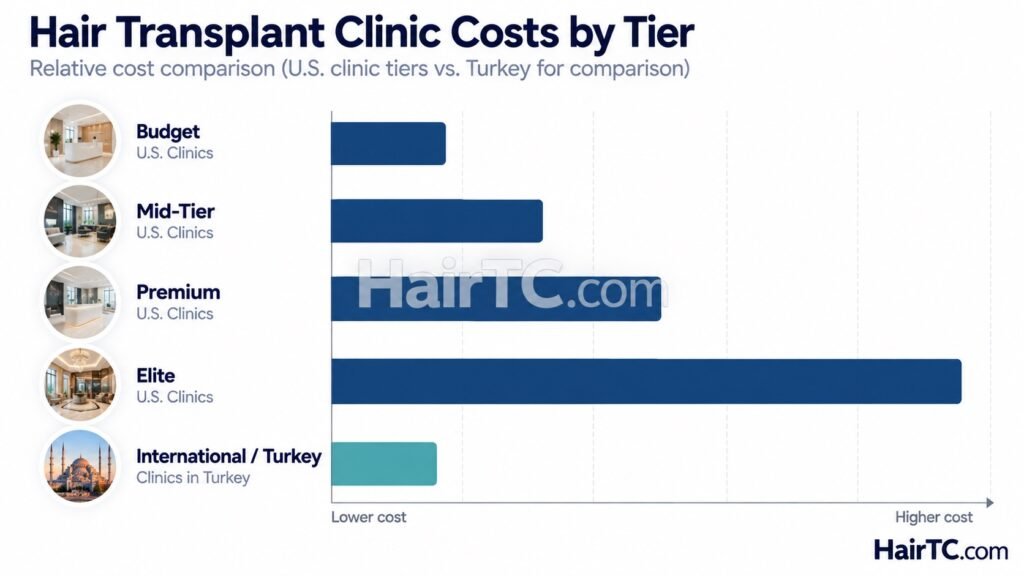
| Clinic Tier | Typical Graft Count | Average Cost (Procedure Only) |
|---|---|---|
| Budget / high-volume | 1,500 – 3,000 | $3,000 – $6,000 |
| Mid-tier accredited | 2,000 – 4,000 | $6,000 – $12,000 |
| Premium / specialist | 2,500 – 5,000 | $10,000 – $18,000 |
| Elite / celebrity surgeon | 3,000 – 6,000 | $15,000 – $25,000 |
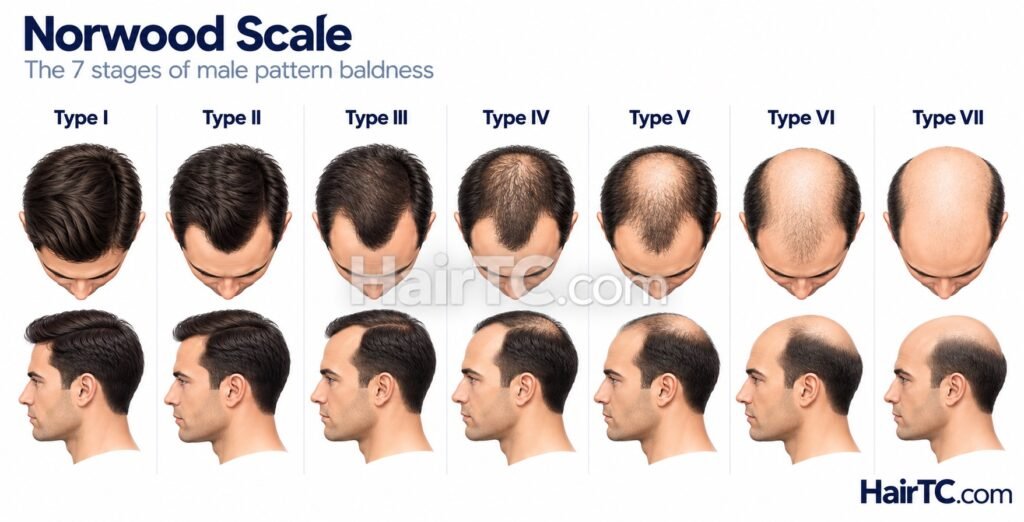
Most patients with moderate to significant hair loss – Norwood stages 3 through 5 – end up in the $7,000 to $14,000 range at reputable mid-to-premium clinics. That’s the realistic budget to plan around if you want a quality result from a surgeon-led practice in the US.
What you see in that table is procedure cost only. By the time you add everything else, the total out-of-pocket number is typically $1,000 to $3,000 higher. The section on hidden costs below breaks that down precisely.
How USA Hair Transplant Pricing Actually Works
Unlike most countries, the US charges per graft rather than per procedure. This distinction matters more than most patients realize when they start comparing quotes.
Per-graft pricing means the clinic estimates how many grafts your case requires and multiplies that by their per-graft rate. If you need 2,800 grafts at $5 per graft, that’s $14,000. If the surgeon determines during the procedure that you actually needed 3,200 grafts, you may be charged for the additional 400, adding $2,000 to your bill.
Average hair transplant cost in USA in 2026:
| Clinic Type | Per-Graft Rate |
|---|---|
| Budget / high-volume operations | $2.00 – $3.50 per graft |
| Mid-tier accredited practices | $3.50 – $6.00 per graft |
| Premium specialist surgeons | $6.00 – $10.00 per graft |
| Elite / nationally recognized | $8.00 – $15.00 per graft |
A few things that per-graft pricing doesn’t capture: the quality of how each graft is handled, whether a surgeon or a technician is doing the implanting, the instruments being used, and the post-operative care included. Two clinics charging $5 per graft are not delivering the same thing.
Some US clinics have moved to flat-fee pricing for specific graft ranges. These are worth comparing carefully against per-graft quotes, flat fees often come with an implicit cap on graft count, and going over that cap adds cost.

Hair Transplant Cost by Graft Count – US Market
Understanding what your graft count will likely be helps you budget realistically before your first consultation.
| Graft Count | Hair Loss Pattern | Typical US Cost Range |
|---|---|---|
| 500 – 1,000 | Hairline refinement only | $2,000 – $5,500 |
| 1,000 – 2,000 | Early recession, temples | $3,500 – $9,000 |
| 2,000 – 3,000 | Moderate crown or front | $6,000 – $14,000 |
| 3,000 – 4,000 | Significant crown + front | $9,000 – $18,000 |
| 4,000 – 5,000 | Advanced loss, Norwood 5–6 | $12,000 – $22,000 |
| 5,000+ | Extensive loss, often two sessions | $16,000 – $30,000 |
Most first-time patients are surprised that their graft count estimate is higher than they expected. Hair transplant results depend on density, too few grafts in a given area produces a thin, unconvincing result. Ethical surgeons quote the graft count your case actually requires, not the lowest number that keeps the quote competitive.
One useful cross-check: if you get three consultations and one surgeon recommends 1,800 grafts while two others recommend 2,800, ask the outlier to explain their reasoning in detail. Very low graft estimates are sometimes a sales tactic.
What Drives the Cost Difference Within the US
Two clinics in the same city can quote $6,000 and $18,000 for nominally the same procedure. Here is what actually explains the gap.
Surgeon credentials and involvement. This is the dominant variable. A nationally recognized hair restoration surgeon who personally performs every stage — hairline design, extraction, channel opening, and implantation — charges more than a practice where a general physician oversees technicians. The surgical skill gap is real and it shows in outcomes. ISHRS fellowship members and surgeons with published research and conference presentations represent the upper end of the credential spectrum.
Facility overhead. A clinic in Midtown Manhattan or Beverly Hills pays ten times the rent of a clinic in suburban Houston. That cost is passed on. You’re partly paying for the zip code, which is why comparing mid-tier practices in secondary markets often produces better value than premium-zip clinics in gateway cities.
Technique. FUE costs more than FUT because it’s more time-intensive. DHI costs more than standard FUE for the same reason. NeoGraft — the US brand name for a specific motorized FUE device — is often priced at a premium despite producing results comparable to skilled manual FUE.
Graft count. Simply: more grafts costs more at per-graft pricing. A 4,000-graft case costs roughly twice a 2,000-graft case at the same clinic.
Staff-to-patient ratios. High-volume operations run four to six patients per day with large technical teams. Single-surgeon boutique practices run one to two patients per day with the physician personally involved at every stage. The experience, the time spent with you, and the outcome consistency differ substantially between these models.
Support and follow-up. Some US practices include comprehensive aftercare programs, PRP treatments, and follow-up appointments in their pricing. Others don’t. Always ask what’s included before comparing quotes on price alone.
Hair Transplant Cost by US City
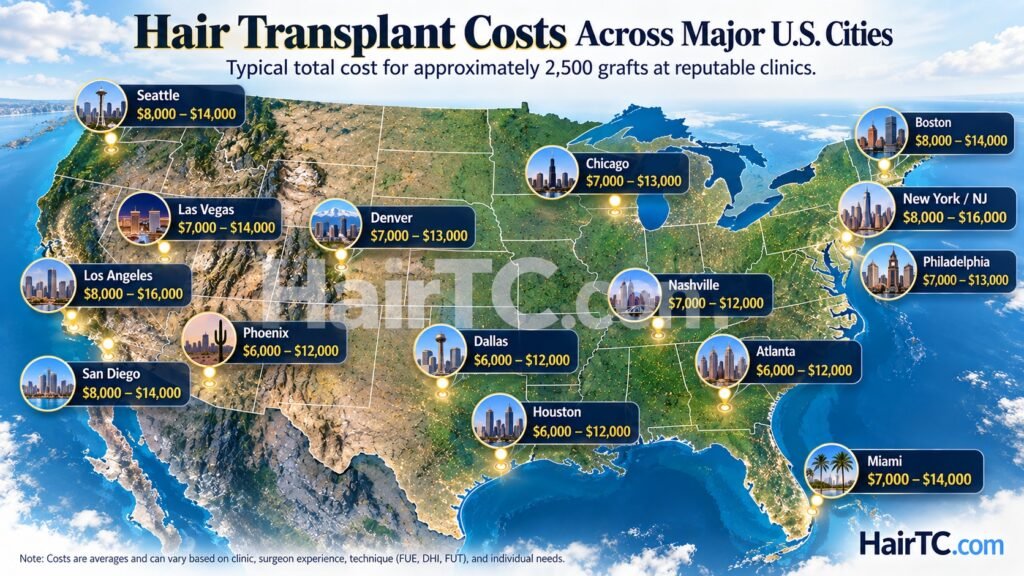
Geography is a real cost driver. Here’s what to expect market by market, based on average pricing at mid-to-premium accredited practices in 2026.
Hair Transplant NYC Cost
Mid-tier range: $8,000 – $15,000 The most expensive domestic market. High real estate overhead in Manhattan is the primary driver. Hair Transplant Clinics in NYC metro area – New Jersey, Long Island, Connecticut – offers meaningfully lower prices for comparable quality. A $14,000 Manhattan quote frequently has a $9,000 equivalent in suburban NJ with a surgeon of similar credentials. Worth the extra research.
Los Angeles / Southern California
Mid-tier range: $9,000 – $18,000 LA is the premium end of the domestic market, driven by entertainment industry demand and celebrity case economics. Several world-class surgeons operate here and have extensive high-profile case portfolios. San Diego represents a more affordable Southern California alternative, typically $6,000 to $13,000 at comparable quality tiers.
Miami / Fort Lauderdale
Mid-tier range: $6,500 – $13,000 One of the most competitive domestic markets. Strong FUE and DHI specialist pool, multilingual capability for Latin American patients, and costs that undercut New York and LA substantially. Miami is a genuine value market for East Coast patients willing to travel.
Chicago
Mid-tier range: $7,000 – $14,000 Solid market with several well-credentialed practices. Suburban Chicago options – Naperville, Schaumburg, Oak Park – tend to run $1,500 to $3,000 less than in-city practices. Chicago is a natural hub for Midwest patients from Indiana, Ohio, Wisconsin, and Michigan.
Houston
Mid-tier range: $5,500 – $11,000 Arguably the best value major market in the country. Low overhead, experienced surgeon pool, and significantly lower costs than coastal cities. Houston KD5 in search data suggests an active market that hasn’t been fully saturated with heavily marketed clinics — which means quality practices are findable. Dallas offers a similar profile at comparable prices.
Dallas / Austin
Mid-tier range: $5,500 – $12,000 Texas overall is the domestic value leader. Dallas and Austin both have established practices, low market overhead, and costs typically 25 to 40 percent below New York and LA for equivalent quality. Austin in particular has seen rapid growth as the city’s population and healthcare market has expanded.
Atlanta
Mid-tier range: $6,000 – $13,000 Growing market serving the Southeast. Several strong FUE specialists. Nashville, Charlotte, and Birmingham are secondary markets worth checking for patients in those regions — fewer specialists but lower costs and occasional standout practices.
Boston / Philadelphia
Mid-tier range: $7,500 – $15,000 Academic medical infrastructure in both cities means dermatology departments with hair restoration divisions. Quality is strong, but pricing reflects Northeast overhead. Philadelphia slightly undercuts Boston; New Jersey undercuts both.
Denver / Phoenix / Las Vegas
Mid-tier range: $6,000 – $13,000 Emerging markets with lower overhead than coastal cities. Phoenix in particular has grown substantially. Las Vegas has a small but active market with some genuinely competitive pricing.
Seattle / Pacific Northwest
Mid-tier range: $6,500 – $14,000 Strong surgical quality, lower competition than California markets. Seattle patients sometimes find better value in the Portland market for standard FUE cases.
The True Cost: What Gets Added to the Base Price
The clinic quote is not your total cost. Here is a realistic accounting of what to add.
Pre-operative consultation fee: $100 – $500 at most US practices. Some clinics credit this toward the procedure cost if you book; many don’t.
Pre-operative blood work and medical clearance: $150 – $400 depending on your health history and what your clinic requires.
Anesthesia: Local anesthesia is included in virtually all US quotes. Sedation or oral anti-anxiety medication may be charged separately at some practices $200 to $800.
PRP therapy: Platelet-rich plasma treatment applied during or after the procedure to support healing and graft survival. Charged separately at most US clinics: $600 – $1,500. Some practices include one session; others charge per session for a recommended series.
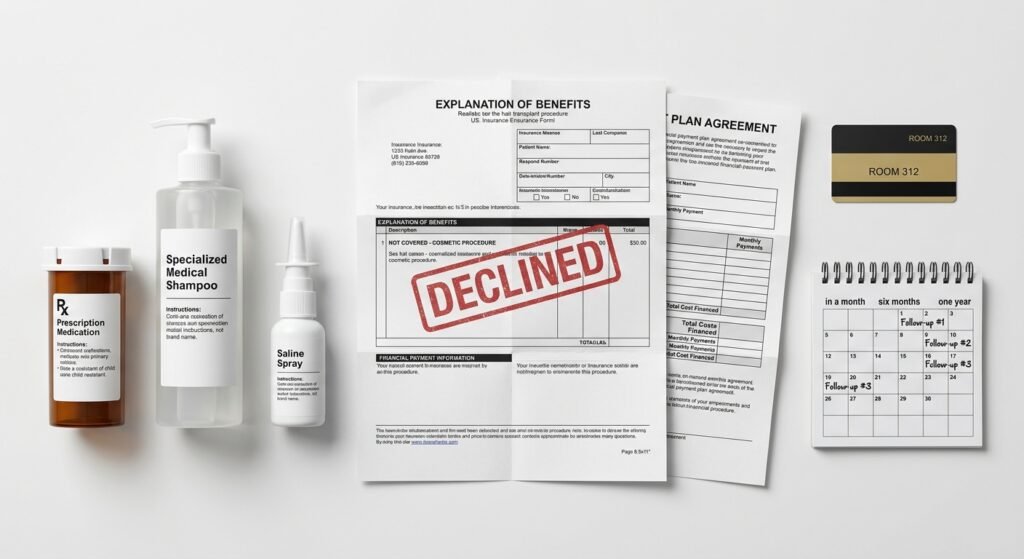
Post-operative medications: Antibiotics, anti-inflammatories, specialized shampoo, saline spray, and sometimes minoxidil starter packs. Budget $150 – $400.
Follow-up appointments: Initial post-op check is usually included. Follow-up visits at months three, six, and twelve may or may not be covered depending on the clinic. Budget $0 – $600 if charged separately.
Travel and accommodation: For patients who travel to a better clinic in another city, add flights, hotel, and ground transport. One or two nights near the clinic is standard practice. Budget $300 – $1,500 depending on distance.
Time off work: A full week of visible healing means most patients take five to seven days off. Factor in PTO value or lost freelance income. This is the hidden cost no clinic mentions.
Long-term medication: Finasteride ($20 – $80/month) or minoxidil ($15 – $40/month) are commonly recommended post-procedure to protect existing hair. These are ongoing costs, not one-time.
Realistic total: Add $1,500 – $3,500 to any US clinic quote for a complete picture of first-year out-of-pocket cost.
Does Insurance Cover Hair Transplants in the US?
This is the most-asked cost question with the least satisfying answer.
Standard hair transplants are not covered by insurance. They are classified as elective cosmetic procedures by every major US insurer. Medicare, Medicaid, and private insurance plans do not cover the procedure under standard policy terms.
The exception is narrow but real. Procedures performed specifically to restore hair lost due to medical causes — alopecia areata in severe forms, scarring from burns, trauma, or surgical procedures, radiation therapy side effects — may qualify for partial coverage under some plans. This requires documentation from a dermatologist or physician establishing medical necessity, and approval is not guaranteed.
If you believe your hair loss has a medical cause rather than genetic pattern baldness, it is worth calling your insurer directly and asking whether hair restoration procedures are covered under any circumstance and what documentation they require. Get the answer in writing.
Health savings accounts (HSAs) and flexible spending accounts (FSAs) are a different story. Because a hair transplant is a medical procedure performed by a licensed physician in a clinical setting, it generally qualifies for HSA and FSA payment. If you have an HSA balance, this is one of the most tax-efficient ways to pay for the procedure, you’re using pre-tax dollars. Check with your HSA administrator to confirm eligibility, but it’s almost universally applicable.
Financing Options for US Hair Transplants
The cost of a quality US hair transplant puts it out of immediate reach for many patients without financing. The good news is that several legitimate options exist.
CareCredit The most widely available medical financing option in the US. CareCredit is accepted at a large percentage of US hair transplant clinics and offers promotional periods of 6, 12, 18, or 24 months with zero interest if the balance is paid in full during the promotional window. After the promotional period, rates jump to 26 to 29 percent APR so the key is treating it as a short-term bridge, not revolving credit.
Alphaeon Credit A CareCredit competitor focused specifically on aesthetic and wellness procedures. Similar promotional structure with zero-interest periods. Accepted at a narrower network than CareCredit but increasingly common at hair restoration practices.
In-house clinic financing Many US clinics offer their own installment plans, particularly for larger procedure costs. Terms vary widely. Some are interest-free for 12 months; others carry rates comparable to credit card APR. Get the full terms in writing before signing specifically the interest rate after any promotional period, the monthly payment amount, and what happens if you miss a payment.
Personal loans For larger procedure costs, a personal loan from a bank or credit union at a fixed APR can be more cost-effective than promotional medical financing if you’re not confident you can clear the balance in the promotional window. Typical APRs for good-credit borrowers run 8 to 16 percent, meaningfully lower than the back-end rate on CareCredit if the promotional period lapses.
Medical credit cards Some patients use a dedicated medical credit card for the procedure and take advantage of introductory 0 percent APR periods. The same discipline applies: treat it as a bridge to pay off within the promotional window.
One important note: a clinic that heavily emphasizes financing options during your initial consultation before you’ve even discussed whether you’re a good candidate for the procedure is using financing as a sales mechanism. The procedure recommendation should come first; financing is just a payment logistics conversation.
Hair Transplant Cost USA vs Turkey:

The Turkey comparison is inevitable in any US hair transplant cost conversation, so here it is directly.
A mid-range quality procedure in the US costs $8,000 to $14,000. The same procedure at an accredited Istanbul clinic costs €2,800 to €4,000 (~$3,080 to $4,400) all-inclusive including hotel, transfers, medication, and follow-up.
The saving is $4,000 to $10,000 depending on your US market. At that level, for many patients, the arithmetic genuinely changes the decision.
When staying domestic makes more sense: You have a medical complexity that benefits from local follow-up access. Your budget is comfortable at the US price. You’ve found a specific US surgeon with a documented track record that aligns closely with your case. You’re not comfortable navigating an international medical trip. Any of these are legitimate reasons to stay home.
When traveling to Turkey makes more sense: The saving is large enough relative to your overall financial situation that it represents a meaningful difference. You’ve done the research and identified a specific accredited Istanbul clinic with verified credentials. You’re comfortable with the follow-up being managed remotely. The saving could fund a second session if needed, which changes the long-term calculation significantly.
The decision isn’t “Turkey is better” or “US is better.” It’s which specific clinic, at which price point, represents the best combination of surgeon quality, facility standards, and total cost for your specific case.
Red Flags in US Hair Transplant Pricing
Not every low price reflects good value, and not every high price reflects quality. These are the signals worth watching for in US clinic pricing specifically.

Quotes given without in-person examination. Any clinic that gives you a firm graft count and total price based solely on photos you sent has not assessed your donor density, scalp health, or hair characteristics properly. That’s a sales figure, not a surgical assessment.
Suspiciously low per-graft rates. In major US cities, per-graft rates below $2.50 typically reflect high-volume operations where technicians perform most of the surgical work. Not automatically a bad outcome, but you should understand exactly what level of physician involvement you’re getting.
Heavy emphasis on the NeoGraft or ARTAS brand names. NeoGraft is a motorized FUE tool. ARTAS is a robotic FUE system. Both are legitimate instruments. Neither is inherently superior to skilled manual FUE, and some clinics charge a significant premium for the brand association. Ask what the evidence is that the device produces better outcomes than their surgeon’s manual technique.
No mention of technique limitations for your case. Every technique has cases where it’s not the optimal choice. A surgeon who recommends the same technique for every patient without discussion of your specific donor characteristics and loss pattern is not conducting a thorough surgical assessment.
Vague or non-existent post-operative protocol. A reputable US practice has a documented post-operative protocol — washing instructions, activity restrictions, medication schedule, follow-up timeline. Practices that hand you a generic sheet and send you home without structured follow-up are treating the procedure as transactional.
Getting Multiple Quotes: How to Compare Properly
You should get a minimum of two consultations, and ideally three. Here’s how to make them comparable.
Ask each clinic to provide:
A written itemized quote specifying what is and is not included. The graft count estimate and the reasoning behind it. The per-graft rate or total package price. What follow-up appointments are included. The specific technique recommended and why. The name and credentials of the surgeon who will perform your procedure and their involvement at each stage.
When you have three quotes in front of you, compare the total all-in cost rather than the headline price. A $9,500 quote that includes PRP, medication, and three follow-up visits may be better value than a $8,000 quote that doesn’t include any of those. Calculate the apples-to-apples number before deciding.
Also compare the graft count recommendations. If they vary by more than 300 to 400 grafts, ask each surgeon to explain the discrepancy. Significant variation in recommendations usually reveals something — either one surgeon is being conservative with donor supply, or another is underselling the graft count to keep the quote competitive.
Frequently Asked Questions
How much does a hair transplant cost in the US in 2026? Most patients at reputable mid-tier US clinics pay between $6,000 and $14,000 for the procedure. Add $1,500 to $3,500 for ancillary costs, pre-op tests, medication, PRP if not included, and follow-up for a realistic total of $7,500 to $17,500 depending on graft count, clinic tier, and city.
What is the average cost per graft in the US? The most common range at credentialed mid-tier practices is $3.50 to $6.00 per graft. Premium specialist surgeons charge $6 to $10 per graft. Budget operations charge $2 to $3.50. For a 3,000-graft procedure, mid-tier cost is approximately $10,500 to $18,000.
Does insurance cover hair transplants in the US? No, for standard male or female pattern hair loss. Insurance classifies hair transplants as elective cosmetic procedures. The exception is hair loss from a documented medical cause — burn scarring, surgical trauma, radiation effects, which may qualify for partial coverage with proper physician documentation. HSA and FSA funds can typically be used for the procedure regardless of insurance classification.
What financing options are available for hair transplants? CareCredit and Alphaeon Credit are the most widely accepted options, offering zero-interest promotional periods of 6 to 24 months. Many clinics offer in-house installment plans. Personal loans from banks or credit unions are worth comparing for larger procedure costs, particularly if you’re not confident you can clear a CareCredit balance within the promotional window.
What is the cheapest hair transplant option in the US? The lowest domestic prices are at high-volume operations in lower-cost markets like Houston, Dallas, and Nashville, where $3,500 to $5,500 procedures exist. These typically involve technician-assisted procedures with limited direct surgeon involvement. For patients who also consider international options, Turkey offers accredited all-inclusive packages at €2,500 to €4,000 (~$2,750 to $4,400) representing better value than most US budget options on both price and quality.
Is a $5,000 hair transplant in the US good value? Potentially, but scrutinize the details. At $5,000, you’re in the budget-to-lower-mid tier. Ask specifically who performs extraction, channel opening, and implantation. If the answer is primarily technicians under physician supervision, you’re getting a different product than a surgeon-performed procedure at $10,000. The outcome at $5,000 can be acceptable, but the risk of suboptimal results is higher.
How much does a hair transplant cost in NYC vs Houston? For a comparable 3,000-graft FUE procedure at accredited mid-tier practices, expect $11,000 to $16,000 in NYC versus $7,000 to $11,000 in Houston. The $4,000 to $5,000 gap reflects real estate and operational cost differences rather than necessarily a quality difference. Some patients travel specifically to Houston or Dallas from coastal cities to access that price differential.
Can I use HSA or FSA funds for a hair transplant? In most cases, yes. Because a hair transplant is a medical procedure performed by a licensed physician in a clinical setting, it generally qualifies for HSA and FSA payment. Confirm with your HSA or FSA administrator, but this is one of the most tax-efficient ways to pay for the procedure — you’re using pre-tax dollars that would otherwise be taxed at your marginal rate.
The Bottom Line on US Hair Transplant Cost
The realistic budget for a quality hair transplant in the US at a mid-tier accredited clinic with verified surgeon involvement is $8,000 to $15,000 all-in, including ancillary costs. Premium specialist practices in major cities run $15,000 to $25,000. Budget operations exist below $6,000 but involve trade-offs in surgeon involvement that are worth understanding before you book.
Geography matters. Houston and Dallas offer the best domestic value. New York and LA carry the highest overhead premium. The difference between equivalent-quality clinics in those markets can be $5,000 to $8,000, enough to justify the cost of travel if you’re in a coastal city.
Insurance won’t help unless you have documented medical hair loss. HSA and FSA funds will. CareCredit is the most practical financing tool for most patients.
And for patients for whom a $4,000 to $9,000 saving meaningfully changes their financial situation: Istanbul’s accredited clinics at €3,000 to €4,000 all-inclusive deserve honest consideration alongside domestic options. The quality gap between the best Turkish clinics and mid-tier US practices is narrow. The price gap is not.

All costs in this guide are in US dollars unless otherwise noted. Prices reflect 2026 market data and vary by case, clinic, and market. Euro/dollar conversions for Turkey comparisons use approximate early 2026 rates (~1.10 EUR/USD). hairtc.com is an independent editorial resource. Sources American Board of Plastic Surgery and ABHRS board.