
The price range for a hair transplant is wider than almost any other elective medical procedure. Depending on where you have it done, which technique your surgeon recommends, and how many grafts your case requires, the total cost runs from under $1,500 to over $25,000, and both ends of that range can be legitimate.
This guide answers the core question directly, then breaks it down by country, by technique, and by graft count, so you understand not just the number but what that number actually means in each context. If you want the complete picture on any specific country, the dedicated country guides below go deeper. This is the overview.

Global Hair Transplant Costs at a Glance
Before the detail — here is the honest one-table summary of what you’ll pay in 2026 at reputable, accredited clinics across the major destination countries.
| Country | Average Cost Range | Pricing Model | Typically All-Inclusive? |
|---|---|---|---|
| USA | $5,000 – $18,000 | Per graft ($3–$10) | No |
| UK | £4,000 – £12,000 | Per graft or flat fee | No |
| Turkey | €2,500 – €5,000 (~$2,750–$5,500) | Flat package | Yes |
| Spain | €3,000 – €7,000 (~$3,300–$7,700) | Per graft or package | Partial |
| Germany | €4,000 – €9,000 (~$4,400–$9,900) | Per graft | No |
| Poland | €1,500 – €3,500 (~$1,650–$3,850) | Package | Partial |
| Mexico | $2,000 – $6,000 | Per graft or package | Partial |
| India | $1,000 – $3,500 | Per graft | Partial |
| Thailand | $2,000 – $5,000 | Package | Yes |
| South Korea | $3,000 – $8,000 | Per graft | No |
| Colombia | $1,500 – $4,000 | Per graft or package | Partial |
| Canada | CAD $7,000 – $18,000 | Per graft | No |
| Australia | AUD $8,000 – $20,000 | Per graft | No |
| Greece | €2,000 – €4,500 (~$2,200–$4,950) | Package | Partial |
| Albania | €1,200 – €2,800 (~$1,320–$3,080) | Package | Yes |
These are procedure costs at vetted, credentialed clinics — not the cheapest available in each market. Budget operations exist below every figure in that table. Understanding what those lower prices represent is as important as the numbers themselves.
Why the Gap Is So Large & What It Actually Means
A $1,500 procedure and a $15,000 procedure aren’t ten times apart in quality. But they’re not the same thing either. The price gap between countries reflects a genuine mix of factors — some that matter clinically and some that don’t.
What explains the gap:
Operating costs dominate. Clinical rent in Manhattan or central London runs twenty to fifty times the equivalent in Istanbul or Guadalajara. Staff salaries reflect national wage levels even at international healthcare standards. Both of these are real cost differences that don’t affect surgical outcome.
Currency and exchange rates. Turkey’s lira, India’s rupee, Thailand’s baht, and Mexico’s peso all buy significantly less in USD or GBP than their nominal procedure prices suggest. The €3,000 Istanbul package represents a genuine cost to the clinic, just expressed in a currency that converts favorably for Western patients.
Procedure volume. Istanbul clinics collectively perform more hair transplants per year than any other country. High volume drives efficiency, keeps per-procedure overhead low, and creates economies of scale in consumables, patient management, and training. Volume is not a quality negative beyond a floor of competence, surgical skill sharpens with repetition.
What doesn’t justify the gap:
Surgical technique. FUE is FUE. The instruments are the same. The biological process is identical. A Choi pen used in Istanbul is the same device used in New York. There is no technique premium embedded in a higher price country.
Post-operative care quality at vetted clinics. Accredited Turkish clinics include more post-operative support in their package price than most US or UK clinics include in their base quote. The comparison actually inverts at this level.
The price difference is real. The quality difference, at equivalent accreditation tiers, is not proportional to it.
Cost of Hair Transplant in USA
Range: $5,000 – $18,000 | Average mid-tier: $8,000 – $13,000
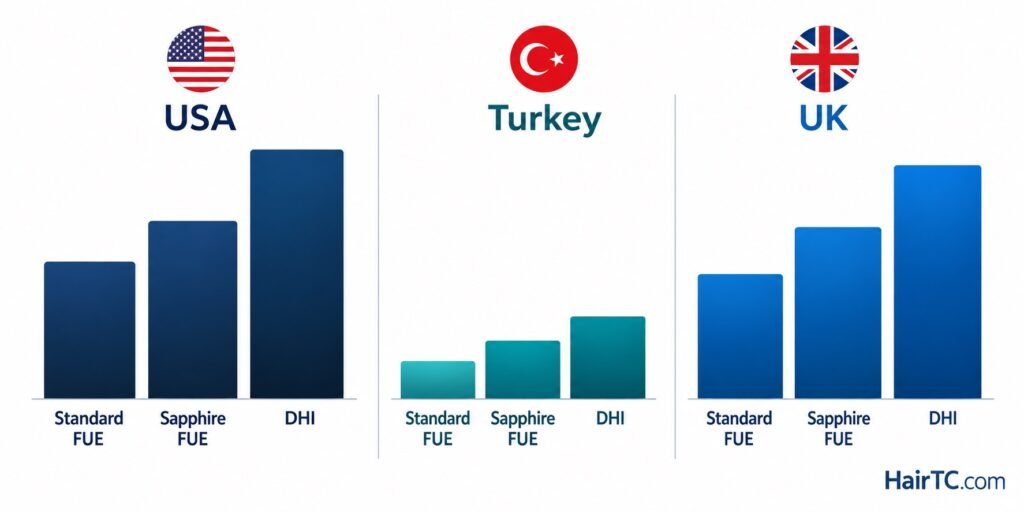
The US is the most expensive domestic market for hair transplants in the world. Per-graft pricing is standard — typically $3 to $10 per graft depending on clinic tier and city. Most quotes do not include hotel, medication, PRP therapy, or follow-up appointments, which add $1,000 to $3,000 to the base figure.
New York and Los Angeles are the most expensive markets. Houston, Dallas, and Nashville are the best value domestic options, typically 25 to 40 percent lower than coastal cities for equivalent quality.
A realistic all-in budget for a mid-tier US procedure: $9,500 to $16,000.
Cost of Hair Transplant in Turkey
Range: €2,500 – €5,500 (~$2,750 – $6,050) | Average mid-tier: €3,000 – €4,000 (~$3,300 – $4,400)
Turkey is the global benchmark for quality-to-cost ratio in hair transplantation. All-inclusive packages at accredited Istanbul clinics cover the procedure, hotel (typically 4-star), airport transfers, medication, and 12 to 18 months of follow-up support.
For US patients: add $700 to $1,100 for return flights. Total cost is approximately $4,000 to $5,500 compared to $9,500 to $16,000 domestically.
For UK patients: add £200 to £380 for return flights. Total approximately £2,800 to £3,700 compared to £5,000 to £10,000 domestically.
The price advantage at the accredited clinic tier is structural and not going away. The research required to identify a quality Istanbul clinic is the investment; the reward is a saving of $4,000 to $10,000 on a single procedure.
Cost of Hair Transplant in UK
Range: £4,000 – £12,000 | Average mid-tier: £5,500 – £8,500
The UK market has a wide quality range. Reputable ISHRS-member practices in London and major cities charge £5,000 to £12,000. Some high-volume chains operate in the £3,000 to £5,000 range, lower costs that typically reflect higher patient volumes and less surgeon involvement per case.
The UK’s proximity to Istanbul (three-hour flight, often under £300 return) makes the medical travel calculation exceptionally straightforward for British patients. A £6,000 UK quote versus a €3,200 (~£2,750) Istanbul package plus £280 flights equals a saving of roughly £2,970 on the mid-range comparison without any meaningful quality trade-off at verified accredited clinics.
Cost of Hair Transplant in Spain
Range: €3,000 – €7,000 (~$3,300 – $7,700)
Spain has developed a strong hair transplant market, particularly in Barcelona and Madrid, with several internationally respected clinics. Pricing sits between Turkey and Germany typically €3,000 to €5,000 for quality mid-tier procedures. Spain is a meaningful option for European patients seeking an alternative to Turkey with shorter travel from Western Europe.
The Spanish market is more regulated than Turkey but less internationally accredited at the highest tiers. Research should focus on ISHRS-member surgeons and clinics with verified independent reviews.
Cost of Hair Transplant in Germany
Range: €4,000 – €9,000 (~$4,400 – $9,900)
Germany’s healthcare infrastructure is excellent and its regulatory standards are high. Hair transplant costs reflect premium German operating costs — typically €4,000 to €9,000 for quality procedures. For European patients who prefer a domestic or near-domestic option with strong regulatory oversight, Germany is a credible alternative to Turkey, though the cost premium over Istanbul is substantial.
Cost of Hair Transplant in Mexico
Range: $2,000 – $6,000 | Average mid-tier: $2,500 – $4,500
Mexico has emerged as the most practical international destination for US patients in the southern and western states. Quality clinics in Mexico City, Guadalajara, Monterrey, and Tijuana offer FUE packages at $2,000 to $5,000, with several clinics now holding international certifications.
The geography is the primary advantage: a two-hour flight from Texas, a three-hour flight from California, and in the case of Tijuana, potentially driveable for patients in San Diego. Travel costs are minimal compared to Istanbul.
The honest limitation: Mexico’s pool of internationally accredited, independently verified hair transplant specialists is smaller than Turkey’s. The research process requires the same rigor ISHRS membership verification, independent review reading, and before-and-after documentation review, but the verified candidate pool is narrower. For the right clinic, Mexico offers genuine value at lower travel costs than Istanbul for US patients.
Cost of Hair Transplant in India
Range: $1,000 – $3,500 | Average mid-tier: $1,500 – $2,500
India offers the lowest headline prices of any established hair transplant market. Reputable clinics in Mumbai, Delhi, Bangalore, and Hyderabad charge $1,000 to $3,500 for procedures that would cost three to five times more domestically in the US or UK.
For patients based in South Asia, the Middle East, or parts of Africa, India is a logical first choice short travel, competitive pricing, and an increasingly strong specialist pool. Several Indian clinics hold international accreditation, and their surgeons hold ISHRS membership.
For US and European patients, the economics are less compelling. A return flight from the US to India runs $800 to $1,400. Add hotel and travel costs, and the all-in savings versus Turkey narrows significantly while the travel time doubles or triples. India makes strong economic sense for patients who can get there affordably. For most Western patients, Turkey offers a better combination of cost, quality verification infrastructure, and travel practicality.
Cost of Hair Transplant in Thailand
Range: $2,000 – $5,000 | Average mid-tier: $2,500 – $4,000
Thailand has a well-developed medical tourism infrastructure and is the regional hair transplant hub for Southeast Asia, Australia, and New Zealand. Bangkok and Phuket have established clinics with all-inclusive packages, JCI-accredited hospital facilities, and strong international patient management systems.
Quality at the top tier is genuine. Bangkok’s major international hospitals, Bumrungrad and Bangkok International, include hair restoration services within internationally accredited healthcare environments that rival any Western institution.
For Australian and New Zealand patients, Thailand is often the most practical international option: competitive cost, relatively short flight, English-speaking medical staff, and a medical tourism infrastructure designed for international patients. For European and American patients, the flight time (10 to 12 hours from Europe, 17 to 20 hours from the US) eliminates most of the financial advantage over Turkey.
Cost of Hair Transplant in South Korea
Range: $3,000 – $8,000 | Average mid-tier: $4,000 – $6,000
South Korea is a significant player in the global hair transplant market, particularly within Asia. Several Seoul-based clinics are among the most technically sophisticated in the world Korea was actually an early innovator in DHI and the Choi pen technique. Costs are mid-range compared to global markets.
For patients based in East Asia, Korea is a natural first choice. For Western patients, the geography and cost equation is less compelling than Turkey.
Cost of Hair Transplant in Poland
Range: €1,500 – €3,500 (~$1,650 – $3,850)
Poland has grown rapidly as a European alternative to Turkey, primarily attracting patients from Germany, the Netherlands, the UK, and Scandinavia. Warsaw and Kraków have several established clinics offering FUE packages at European quality standards but at prices substantially below Western European markets.
Poland occupies an interesting middle position: Turkish pricing with Western regulatory oversight. For European patients who want the cost advantage of medical tourism but prefer to stay within the EU and its consumer protection framework, Poland is increasingly worth considering. The clinical quality at top Polish clinics is genuine, though the depth of the specialist pool and the volume of independently verified outcomes are smaller than Turkey’s.
Cost of Hair Transplant in Colombia
Range: $1,500 – $4,000 | Average mid-tier: $2,000 – $3,500
Colombia — specifically Bogotá and Medellín — has developed a meaningful medical tourism sector. Hair transplant costs at established Colombian clinics are competitive, and the country has become a regional hub for Latin American patients. For US patients, flight times are three to five hours from major East Coast cities.
The Colombian market’s quality verification infrastructure is less developed than Turkey’s or India’s in terms of international accreditation density, but several clinics hold ISAPS or ISHRS affiliations. Research requires the same due diligence discipline as any international market.
Cost of Hair Transplant in Greece and Albania
Greece: €2,000 – €4,500 (~$2,200 – $4,950) Albania: €1,200 – €2,800 (~$1,320 – $3,080)
Both countries have developed small but active hair transplant markets, primarily serving European patients. Greece offers reasonable pricing with solid European regulatory oversight. Albania, particularly Tirana has become a budget European destination with very low pricing, though the quality verification infrastructure is notably thin. Albania requires the most careful independent research of any European destination on this list.
Cost of Hair Transplant in Canada and Australia?
Canada: CAD $7,000 – $18,000 (approximately US $5,100 – $13,100) Australia: AUD $8,000 – $20,000 (approximately US $5,200 – $13,000)
Both markets follow similar pricing and structural patterns to the US and UK, respectively per-graft pricing, procedure-only quotes, and significant city-to-city variation. Toronto and Vancouver are Canada’s primary markets. Sydney, Melbourne, and Brisbane are Australia’s.
For patients in both countries, the medical tourism calculation follows the same logic as for US and UK patients: the savings versus Istanbul is significant, the travel is long but manageable, and the research investment required to find a verified clinic is the same.
Hair Transplant Cost by Graft Count: Global Reference
Regardless of country, graft count is the underlying driver of procedure cost. Here is what different graft counts typically mean across markets.

| Graft Count | Hair Loss Pattern | USA Cost | Turkey All-In | India All-In |
|---|---|---|---|---|
| 500 – 1,000 | Hairline only, minor recession | $2,000 – $5,500 | €1,500 – €2,200 (~$1,650–$2,420) | $800 – $1,500 |
| 1,000 – 2,000 | Early recession, temples | $3,500 – $9,000 | €2,000 – €3,000 (~$2,200–$3,300) | $1,000 – $2,000 |
| 2,000 – 3,000 | Moderate loss, Norwood 3–4 | $6,000 – $14,000 | €2,500 – €3,800 (~$2,750–$4,180) | $1,500 – $2,800 |
| 3,000 – 4,000 | Significant crown + front | $9,000 – $18,000 | €3,000 – €4,500 (~$3,300–$4,950) | $2,000 – $3,500 |
| 4,000 – 5,000 | Advanced loss, Norwood 5–6 | $12,000 – $22,000 | €3,500 – €5,500 (~$3,850–$6,050) | $2,500 – $4,500 |
The Package Comparison: What All-Inclusive Means
The headline price comparison between countries is only meaningful when you understand what each price includes. This is the detail that changes the real cost calculation.

A standard US or UK clinic quote typically includes the procedure itself and local anesthesia. That’s it. Consultation fees, pre-operative blood work, post-operative medication, PRP therapy, follow-up appointments, and any revision work are typically additional.
A standard Istanbul all-inclusive package typically includes: The full procedure (all grafts needed), pre-operative blood tests, local anesthesia, three to five nights at a partner hotel, airport and clinic transfers throughout your stay, a multilingual patient coordinator, post-operative medication pack, specialized aftercare shampoo and saline spray, the first clinical hair wash, and twelve to eighteen months of structured follow-up support.
When you adjust the US or UK procedure quote to include the same items two nights at a hotel near the clinic, medication, PRP, and follow-up appointments the real comparison looks like this for a 3,000-graft FUE procedure:
| Procedure Quote | Add Hotel + Meds + PRP + Follow-up | Real Total | |
|---|---|---|---|
| US mid-tier clinic | $10,000 | + $2,000 | $12,000 |
| Istanbul all-inclusive | €3,300 (~$3,630) | + Flights $850 | ~$4,480 |
| Savings | ~$7,520 |
The savings are real, and the quality at verified, accredited clinics is comparable. This is the calculation that drives the steady growth in medical tourism for hair restoration.
The Budget Floor: What to Know Before Going Cheap
Every country in this guide has a budget tier below the numbers listed above. And in every country, that budget tier represents a meaningfully different product.
The warning signs are the same globally technician-led procedures with minimal surgeon involvement, no verifiable accreditation, unverifiable before-and-after documentation, and inadequate follow-up support. These aren’t problems specific to Turkey or India or Albania. The same issues exist at the $3,000 end of the US market.
The approximate minimum price for a procedure worth trusting at verified quality clinics by country:
| Country | Minimum trustworthy price |
|---|---|
| USA | $5,000 (procedure only, 2,000 grafts) |
| UK | £4,000 (procedure only) |
| Turkey | €2,000 (~$2,200) all-inclusive |
| Spain / Greece | €3,000 (~$3,300) |
| Poland | €1,500 (~$1,650) |
| Mexico | $2,000 all-inclusive |
| India | $1,200 all-inclusive |
| Thailand | $2,000 all-inclusive |
| Albania | €1,500 (~$1,650) — requires extra scrutiny |
Below these floors, the risk-reward calculation shifts unfavorably. Not because quality procedures can’t exist at lower prices in exceptional circumstances, but because the economics of running a clinic below those thresholds require compromises that reliably affect outcomes.
The Real Total Cost: What to Budget For
The quoted price wherever you go is the starting point, not the endpoint. These additions apply globally.
Flights: Zero if you stay domestic. $600 to $1,400 to Istanbul from the US. $150 to $400 from the UK. $400 to $900 from Australia. $200 to $500 to Mexico from Texas or California.
Travel insurance with medical coverage: $50 to $200 depending on trip length and coverage level. Non-negotiable for any international medical procedure.
Personal spending during your stay: Meals, city transport, optional activities. $200 to $500 depending on destination and duration.
Long-term medication: Finasteride ($20 to $80/month) or minoxidil ($15 to $40/month) are commonly recommended post-procedure to protect existing hair. These are ongoing costs that continue regardless of where you had the procedure.
Potential second procedure: A meaningful percentage of patients — particularly those with advanced or progressive loss — require a second session within five to ten years. Budgeting for this as a possibility rather than being surprised by it is the most practical approach to long-term cost planning.
Medical Tourism: The Decision Framework
For any patient seriously considering international treatment, the decision framework is the same regardless of which country you’re comparing against your home market.

Step 1: Establish your domestic benchmark. Get at least two in-person consultations from qualified surgeons in your home market. Know what they recommend, what it costs, and what their before-and-after documentation shows. This gives you a real comparison point rather than an abstract one.
Step 2: Identify specific international clinics. Don’t evaluate “Turkey” or “India” — evaluate specific clinics. Verify their JCI, TEMOS, or ISO accreditation directly at the accrediting body’s registry. Confirm the lead surgeon’s ISHRS membership at ishrs.org. Read independent reviews on Trustpilot, Google Maps, and RealSelf at volume — not the clinic’s own testimonials page.
Step 3: Run the true total cost comparison. Procedure plus ancillaries (hotel, medication, PRP, follow-up) at home. Procedure plus flights plus accommodation plus insurance abroad. The real number is what you compare, not the headline quote.
Step 4: Have a video consultation with the actual surgeon. Not just a patient coordinator. A surgeon who takes twenty minutes to review your case, explain their approach, and answer your questions before you book your flights is demonstrating the level of attention you’ll receive during the procedure.
Step 5: Make the decision based on evidence, not fear or marketing. The two common failure modes are: (a) dismissing international options without researching them properly, and (b) booking an international clinic based on price without doing the verification work. Both lead to suboptimal outcomes.
Frequently Asked Questions
How much does a hair transplant cost on average? Globally, the average cost at reputable clinics ranges from $1,500 to $18,000 depending on country, technique, and graft count. In the US, the average mid-tier procedure runs $8,000 to $13,000 for the procedure alone. In Turkey, equivalent quality procedures run €2,800 to €4,000 (~$3,080 to $4,400) all-inclusive. The global weighted average for a quality 3,000-graft FUE procedure is roughly $6,000 to $8,000 across all major destinations.
What is the cheapest country to get a hair transplant? India and Albania offer the lowest headline prices, with reputable clinics from $1,000 to $3,500 in India and €1,200 to €2,800 (~$1,320 to $3,080) in Albania. For most Western patients, India requires significantly more travel than Turkey, which offers comparable quality at moderately higher but still very competitive prices. Albania requires particularly careful clinic verification due to a less developed international accreditation ecosystem.
Is a hair transplant cheaper in Turkey than the USA? Yes, significantly. A comparable quality procedure at an accredited Istanbul clinic costs approximately €3,000 to €4,000 (~$3,300 to $4,400) all-inclusive, versus $9,000 to $14,000 at a mid-tier US clinic for the procedure alone. Adding flights and insurance for the Turkey trip, the total savings for a US patient is typically $4,000 to $9,000 on a single procedure.
Why is hair transplant so much cheaper in Turkey and India? Lower operating costs — real estate, staff wages, and administrative overhead are the primary drivers. High procedure volumes create efficiency economies that further reduce per-procedure costs. Currency exchange rates allow clinics to operate profitably at prices that convert to modest amounts in USD or GBP. These are structural economic differences, not signals of inferior quality at accredited clinics.
How much does a hair transplant cost in Mexico? Quality clinics in Mexico City, Guadalajara, Monterrey, and Tijuana charge $2,000 to $6,000 for FUE procedures, with all-inclusive packages at the better clinics running $2,500 to $5,000. Mexico is the most geographically practical international option for US patients in Texas, California, and the Southwest.
What is the cost of a hair transplant in India? Reputable Indian clinics charge $1,000 to $3,500 all-inclusive the lowest prices of any established market. Major centers include Mumbai, Delhi, Bangalore, and Hyderabad. For patients already based in or near South Asia, India is often the best value option. For US and European patients, travel costs reduce the economic advantage versus Turkey.
Does the country you choose affect the quality of results? Not necessarily, when comparing accredited clinics within their quality tier. FUE results at a JCI-accredited Istanbul clinic are clinically comparable to FUE results at an accredited US practice of equivalent surgeon skill and graft count. Country affects cost, travel logistics, follow-up accessibility, and regulatory recourse not the surgical technique or biology of hair growth.
What financing options exist for hair transplants internationally? US patients can use HSA or FSA funds for domestic procedures. CareCredit and personal loans are available for US clinics. For international procedures, most Turkish and Indian clinics accept credit cards, and some offer installment plans for international patients. A few specialist medical travel financing services also exist. Travel rewards credit cards can partially offset international flight costs.
Country Comparison: The Bottom Line
The right country for your hair transplant is the one that gives you the best combination of surgeon quality, verifiable accreditation, total cost, and travel practicality for your specific situation.
For US patients: Turkey offers the best global value when research is done properly. Mexico is the best option for patients who want international pricing at minimal travel cost. Staying domestic makes sense for patients with medical complexity, strong local surgeon relationships, or for whom the saving isn’t financially meaningful.
For UK patients: Istanbul is three hours and under £300. The economics of Turkey versus domestic UK treatment are the most compelling of any patient nationality. Poland is a closer EU alternative worth considering.
For Australian and New Zealand patients: Thailand offers a practical regional option with genuine clinical quality at competitive prices.
For everyone: the research investment required to find a quality clinic anywhere is the same. The reward varies by destination. Do the work before you book anything.

All prices in this guide reflect 2026 market data and are subject to change. Euro/dollar conversions use approximate early 2026 exchange rates (~1.10 EUR/USD). Country price ranges represent vetted, credentialed clinics not the cheapest available. hairtc.com is an independent editorial resource and does not accept payment from clinics for coverage or rankings.