
The hardest part of a hair transplant isn’t the procedure. It’s the waiting.
Most patients aren’t prepared for what the first few months actually look like. The grafts shed. The scalp looks worse before it looks better. Month three arrives, and the mirror still doesn’t show much. Then somewhere between months six and nine, something changes, and by months twelve to eighteen, the result you flew to Istanbul or paid $10,000 for finally reveals itself.
This guide covers every stage of that journey in honest detail, month by month, from the day of your procedure through to your final result at eighteen months. What’s normal, what isn’t, what you should be doing, and what you should stop worrying about.
Hair Transplant Timeline at a Glance
| Time Point | What’s Happening | What You See | Patient Experience |
|---|---|---|---|
| Day 0–3 | Grafts anchoring, swelling peaks | Bandaging, crusts, forehead swelling | Uncomfortable but manageable |
| Day 4–10 | Scabs forming, follicles integrating | Scabs resolving, donor area healing | Itching, tightness follow wash protocol |
| Week 2–4 | Blood supply establishing | Hair stubs present, calm scalp | The quiet phase restrictions still important |
| Month 1–2 | Shock loss (telogen effluvium) | Transplanted hair sheds | Alarming but completely normal |
| Month 3 | Ugly duckling phase | Sparse, uneven, possibly worse than before | Most difficult psychological period |
| Month 4–5 | Early anagen, first real growth | Fine new hairs emerging | Confidence begins returning |
| Month 6 | ~50–60% final density | Hairline defined, coverage visible | Major psychological milestone |
| Month 7–9 | Thickening, normalizing texture | Good density, natural hairline showing | Barbers start to notice |
| Month 9–12 | 70–80% final density | Natural result, feels like your own hair | Emotional payoff arrives |
| Month 12–18 | Final maturation | Thickening, late follicles activating | Subtle improvements continue |
| Month 18+ | Permanent result established | Final density and texture normalized | Hair is simply your hair |
Why Hair Transplant Recovery Timeline Is Longer Than You Think
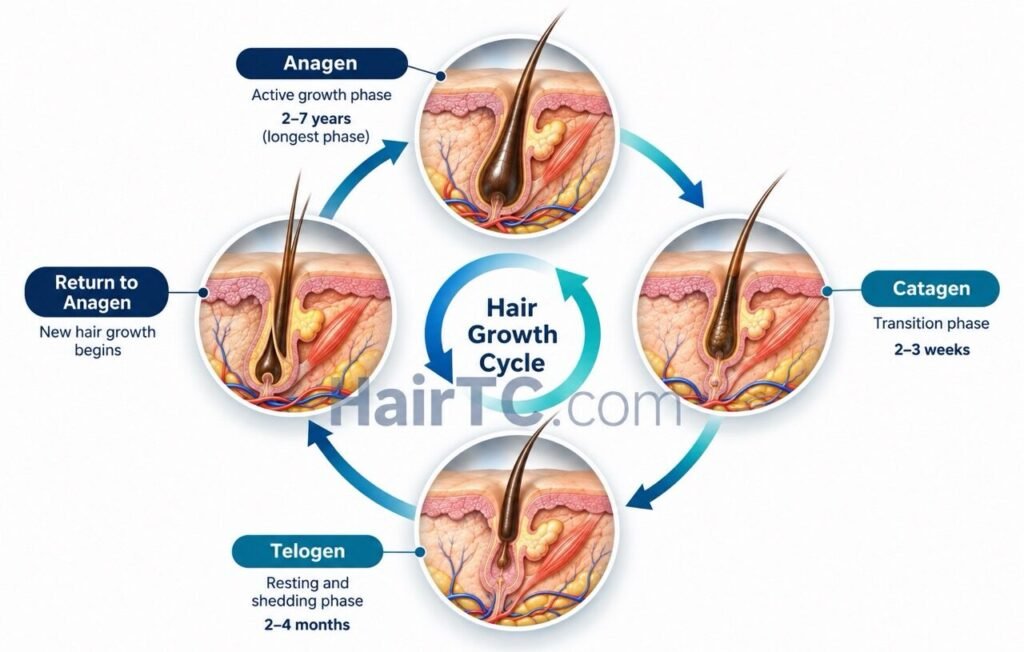
Hair grows in cycles. Your transplanted follicles don’t simply move from one location to another and carry on growing; they go through a complete biological reset. After extraction and implantation, every transplanted follicle enters a resting phase called telogen. The hair shaft sheds. The follicle lies dormant. Then, when it’s ready, it wakes up and begins a new growth cycle from scratch.
This is why the timeline from procedure to final result spans eighteen months rather than three. You’re not watching existing hair grow; you’re watching new hair cycles initiate, one by one, across thousands of individual follicles. They don’t all start at the same time, which is why the growth comes in gradually and unevenly before it fills in.
Understanding this biology is the single most important thing you can do for your mental state during the process. Almost every concern patients develop in months one through four the shedding, the patchiness, the visible scalp is the normal biology of follicular reset, not evidence that something went wrong.
Procedure Day and the First 24 Hours
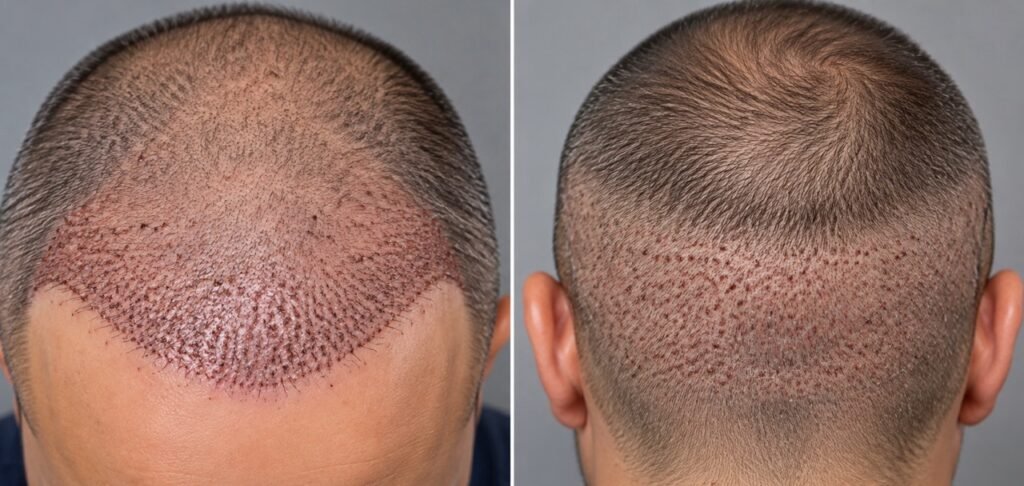
You leave the clinic bandaged, slightly swollen, and with tiny dots visible across the recipient area either the implanted grafts or the scabbing that forms immediately over the implantation sites. The donor area at the back of your head feels tender and tight.
This is what normal looks like on day zero.
The first 24 hours require specific care. Sleep with your head elevated at around 45 degrees use a travel pillow behind your neck or stack pillows under your upper back. This minimizes swelling in the forehead and around the eyes, which is a natural consequence of surgical fluid migration and typically peaks around days three to four before resolving on its own.
Don’t touch the recipient area. Don’t let water run directly over it. Don’t bend over vigorously or do anything that raises blood pressure sharply. The grafts are sitting in newly opened channels and are vulnerable to physical displacement for the first several days.
Most clinics will have you return the following morning for your first clinical hair wash, which is performed carefully by the nursing team. After that, you’ll receive detailed instructions for washing at home.
Days 1 to 10: The Immediate Post-Op Phase
Days 1 to 3
Swelling arrives in this window and can be significant. Many patients wake on day two or three to find their forehead notably puffy, sometimes with bruising around the eyes. This is universally alarming the first time you see it and universally normal. It’s the surgical fluid, not blood, not infection, redistributing downward under gravity. It resolves completely within five to seven days without any intervention.
The recipient area will develop small crusts or scabs over each implantation site. These are protective and should not be picked or scratched. Your clinic’s washing protocol typically involves a gentle application of saline spray followed by a diluted shampoo, applied without direct water pressure, designed to soften and eventually remove these scabs without disturbing the grafts beneath.
The donor area feels tight and may itch. This is nerve healing and is expected. Resist the urge to scratch.
Days 4 to 7
Swelling peaks and begins to subside. The scabs are developing, and the scalp may feel uncomfortably tight and itchy. Some patients notice small amounts of dried blood or weeping from the donor area; this is normal and resolves quickly.
You can sleep in a more normal position from around day five for most patients, though elevated sleeping is still protective if you’re able.
Days 7 to 10
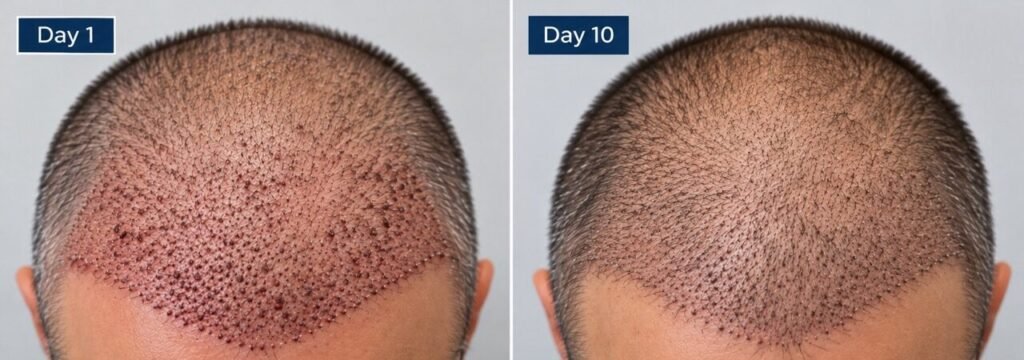
The grafts are now anchored. By day ten, the implanted follicles are physically secured through tissue integration and the risk of graft displacement from normal activities drops dramatically. Most clinics give you an all-clear for gentle exercise and more normal showering around this point, though direct sun on the scalp, swimming, and strenuous physical activity are still off the table for several more weeks.
The scabs should be softening and beginning to fall away naturally through your washing routine. Don’t force them. Premature removal can displace or damage the follicle beneath.
10 days after hair transplant is one of the most searched time points, largely because patients at this stage start to wonder if things are progressing normally. The answer, in almost every case, is yes. Scabs present, some redness, donor area healing all normal.
Week 2 to 4: The Quiet Phase
The visible drama of the first week settles. Swelling is gone. Scabs have resolved or are close to it. The recipient area looks relatively calm; you can see the transplanted hair shafts as short stubble across the implanted zone.
This is also the window when many patients make their first mistake: assuming things are going well and returning to normal activities prematurely. The grafts are anchored, but the follicles are still establishing their blood supply in the new location. Hard exercise that raises core temperature significantly, alcohol, smoking, and direct sun exposure all inhibit the vascularization process that determines how well each follicle takes root.
Follow the restrictions your clinic set. The two- to four-week window is the most critical period for graft survival, even if it looks like everything is fine.
You can return to desk work within a few days of the procedure in most cases. Physical labor, contact sports, and swimming pools require the full four to six-week clearance period.
Month 1 to 2: The Phase Nobody Warned You About
This is the phase that sends patients to forums in a panic, certain something has gone catastrophically wrong. It hasn’t.
Between weeks three and eight, most patients experience what is clinically called telogen effluvium, colloquially known as shock loss. The transplanted hair shafts fall out. Not all at once, but progressively, until the recipient area looks sparser than it did before the procedure and possibly sparser than it looked before you had the transplant at all.
IMAGE: prompt — 6 weeks quite phase
What’s actually happening
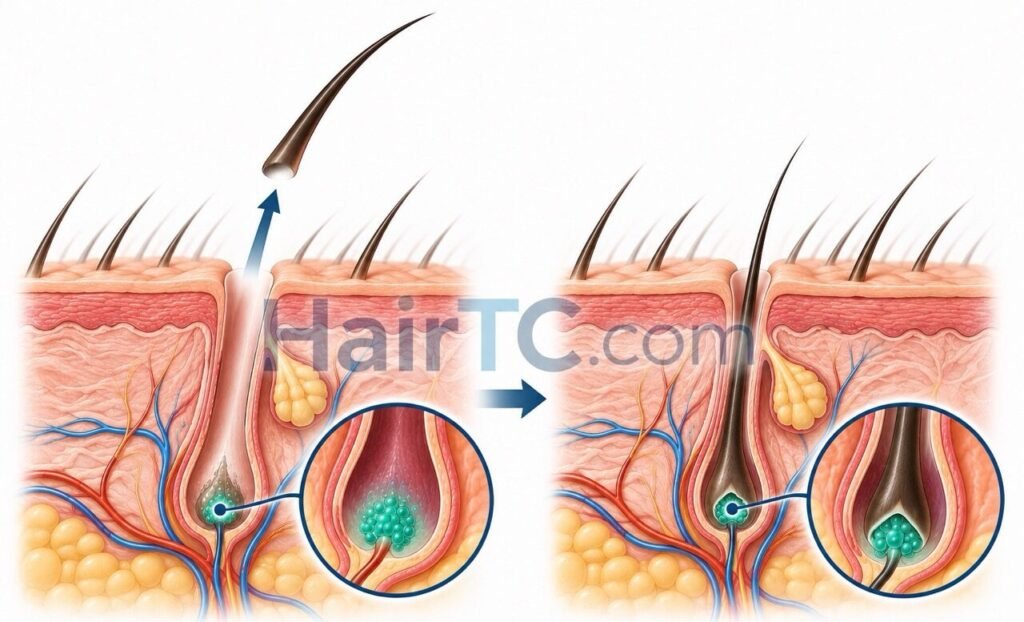
The transplanted follicles are not dying. The hair shafts that shed are simply the existing hair attached to follicles that have entered telogen (the resting phase) as a response to the trauma of transplantation. The follicle root remains alive and will initiate a new growth cycle, but first it needs its rest period, which typically lasts six to eight weeks.
Think of it this way: the hair shaft is not the follicle. You lose the hair. You keep the root that grows it. The root is what matters.
Native hair shock loss
In some patients, nearby non-transplanted native hair also experiences shock loss in response to the surgical trauma to the scalp. This is more common in patients who had fine or weakened existing hair in the recipient zone. It is usually temporary and resolves as part of the same recovery process, though in patients with advanced miniaturization it can occasionally be partially permanent. This is one reason good surgeons are conservative in areas with significant existing hair: the temporary disruption can reveal how fragile that hair already was.
What to do during shock loss
Nothing except continue your prescribed medication and follow-up protocol. Finasteride, if your surgeon has recommended it, is most important during this phase because it protects your existing native hair from the DHT-related miniaturization that causes ongoing loss. Minoxidil, if prescribed, supports blood flow and can slightly accelerate follicular reactivation.
The worst thing you can do is panic and start trying every supplement and laser treatment you’ve read about. Introduce nothing new to your protocol without consulting your surgeon, because the interaction effects of adding multiple treatments simultaneously make it impossible to understand what’s helping or hurting.
Month 3: The Ugly Duckling Phase
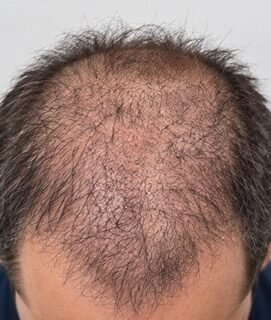
Month three is when patience reaches its peak test. Shock loss has done its work, and the new growth hasn’t meaningfully begun. The scalp may look genuinely worse than it did before the procedure. Patients who made the decision after years of anxiety about their hair now wonder if they made a catastrophic mistake.
This phase has a widely used nickname in the hair restoration community: the ugly duckling phase. It’s universal, well-documented, and temporary.
What’s happening biologically is that some follicles have begun initiating their new anagen phase and are producing the earliest, finest hair shafts so fine they’re barely visible or have a wiry, irregular texture unlike your normal hair. Other follicles are still in their rest phase. The patchiness and unevenness of what you can see is a function of follicles being at different points in their individual reset cycles, not a sign of poor graft survival.
3 months after hair transplant photos is heavily searched precisely because people at this stage want to compare what they’re seeing with documented cases at the same point. The consistent message from patient documentation is: month three looks rough, and that’s normal.
Month 4 to 5: The First Signs of Real Growth
Somewhere in the month four to five window, most patients notice it. A definite texture emerging where there was none. Fine hairs that are growing noticeably rather than just present. The hairline beginning to show its intended shape.
This is the phase where confidence starts to return. The growth is still limited; you’re looking at perhaps 20 to 30 percent of your eventual density, but the direction is unmistakably positive, and the worst is clearly behind you.
The hair that’s growing at this stage is often finer and slightly different in texture than your native hair. This is normal. The follicles are producing hair in the early anagen phase, which is characteristically fine before it thickens with subsequent growth cycles. By months eight to twelve, the caliber of the transplanted hair will normalize to match your donor hair.
Some patients also notice the new hair grows in slightly curly or wavy during this phase even if their hair is naturally straight. This is another early anagen characteristic and straightens out with continued growth.
Month 5 to 6: Building Momentum
Month six is the checkpoint most surgeons use for initial outcome assessment, and it’s the point where most patients start feeling genuinely comfortable going out without concealment.
By month six, the average patient has achieved around 50 to 60 percent of their final density. The hairline is visible and defined. The coverage has improved substantially from the ugly duckling phase. The new hair is thickening and, for most patients, beginning to blend naturally with existing native hair.
Hair transplant 6 months vs 1 year is a frequently searched comparison and for good reason. Month six feels like a major milestone, but there’s significant additional development still to come. The density at six months is approximately half the density at twelve months for most patients.
Patients who were anxious throughout months one through four typically describe month six as the point where their confidence in the decision is restored. The progress is visible, the direction is clear, and the result is starting to look like what they hoped for.
Month 6 to 9: Thickening and Refinement
The hair that began emerging in months four and five is now growing and thickening through its first complete growth cycle. The texture normalizes. The caliber of individual hair shafts increases. Patchiness in the recipient zone continues to fill as the remaining dormant follicles complete their rest phase and initiate growth.
This is also the phase where the hairline’s aesthetic quality becomes most apparent. The artistry of the surgeon’s hairline design the placement of single-hair follicular units in the very front rows to create a soft, natural transition becomes visible as those fine-caliber hairs grow in at the correct angles.
Patients with naturally curly or textured hair often find this phase particularly rewarding because the density of their hair type makes the growth appear more dramatic in the transition from sparse to full.
One practical note: this is the phase when barbers start to notice. If you haven’t told people about the procedure, months seven to nine is approximately when the hair looks different enough from before that questions might be asked.
Month 9 to 12: The Transformation Becomes Real
Month nine through twelve is when most patients experience the emotional payoff they’ve been waiting for since the procedure. The density has reached approximately 70 to 80 percent of the final result. The hair looks, to everyone except the patient who knows where it came from, entirely natural.
For most people, this is the phase where the procedural decision feels completely vindicated. They stop thinking about the transplant constantly. They stop checking their scalp in every mirror. The hair just becomes their hair.
The donor area has fully healed and, in FUE procedures, shows no visible scarring at normal hair lengths. The back and sides look entirely natural. The extraction points from the FUE procedure are invisible unless you shave to skin level.
Any remaining thin patches, usually in the crown or mid-scalp areas where follicles take the longest to activate, are still developing. Month twelve results are not final results.

Month 12 to 18: Final Maturation
The final six months of the timeline are about maturation rather than dramatic change. The density is largely in place by month twelve, but three things continue to develop through eighteen months.
Hair shaft caliber. Individual hairs continue thickening as they complete additional growth cycles. The difference between the hair at month twelve and month eighteen isn’t primarily more hairs; it’s thicker, stronger hairs.
Late-activating follicles. A small percentage of follicles, typically in the range of 5 to 15 percent, don’t initiate their growth cycle until months twelve through eighteen. These late growers are most common in the crown area and in patients who had lower donor hair density. Their contribution to the final result is meaningful but gradual.
Texture and behavior normalization. The transplanted hair fully adopts the characteristics of its donor origin the wave pattern, the growth rate, and the seasonal shedding patterns by eighteen months. It behaves exactly like your native hair because it is your native hair, just relocated.
Month 18 and Beyond: Is Hair Transplant Permanent?
Yes, with an important qualification.
The transplanted hair is taken from the donor zone at the back and sides of the scalp, areas that are genetically resistant to the DHT (dihydrotestosterone) hormone responsible for male pattern baldness. When those follicles are moved to the top of the scalp, they retain their DHT-resistant genetics. They continue to grow for life just as they would have in the donor area.
The qualification is your existing native hair. The transplant does not prevent the ongoing loss of non-transplanted hair. If your natural hair continues to recede around or behind the transplanted zone, you may develop an uneven appearance over time dense transplanted hair surrounded by continuing natural loss.
This is why your surgeon’s long-term planning matters as much as the immediate result. A well-designed transplant anticipates where your hair loss will progress based on your age, loss pattern, and family history, and designs the hairline and density distribution to remain natural-looking as that progression occurs. It also preserves sufficient donor supply for potential future sessions if they’re needed.
Finasteride, if you’re a candidate and choose to take it, significantly slows or arrests the progression of surrounding natural loss and extends the period before any additional intervention becomes relevant.
Frequently Asked Questions
When does hair start growing after a transplant? The first fine hairs typically emerge between months three and five. Month four is the most common point where patients notice definite new growth. The hair that appears before this- the stubble visible in weeks one and two is the original hair shaft that will shed during shock loss. True new growth from the reset follicle begins in the month three to five window.
Is shock loss normal after a hair transplant? Yes, completely. Shock loss, the shedding of transplanted hair shafts in weeks three to eight, is experienced by the majority of patients to some degree. It represents the follicles entering a resting phase before initiating a new growth cycle. The follicle root remains intact, and the hair regrows. It is not evidence of graft failure.
What does 3 months after a hair transplant look like? Month three is the ugly duckling phase. For most patients, the recipient area looks sparse and uneven; the shed hair has gone, and the new growth is minimal or just beginning. It often looks worse at three months than it did before the procedure. This is entirely normal and temporary.
When can I see the final result of my hair transplant? Final results are assessed at eighteen months. By twelve months, most patients have seen 80 to 90 percent of their final density. The remaining development between months twelve and eighteen involves thickening of existing hairs and activation of the last dormant follicles.
How long does hair transplant recovery take? Social recovery, being comfortable going out in public, typically takes two to four weeks for most patients once the scabs have cleared. Physical recovery, returning to full exercise, swimming, and normal activity, takes four to six weeks. Full biological recovery and final results take eighteen months.
Does shock loss affect all transplanted hair? The degree of shock loss varies significantly between patients. Some experience almost complete shedding of transplanted hair shafts. Others see only partial shedding. Factors include the technique used, the individual’s healing response, and the health of the follicles. DHI and Sapphire FUE may produce slightly less shock loss than standard FUE due to reduced handling time outside the body, though individual variation is the dominant factor.
Why is my transplanted hair curly at month 4? Fine curling or waviness in early anagen hair is a normal characteristic of young hair shafts emerging from recently activated follicles. It resolves as the hair grows longer and completes its first full cycle. By months six to eight, the texture normalizes to reflect the natural characteristics of your donor hair.
Should I take finasteride after a hair transplant? This is a conversation to have with your surgeon based on your individual situation. Finasteride protects existing native hair from DHT-related loss and is commonly recommended for patients continuing to experience natural hair loss progression. It does not affect the transplanted hair, which is already DHT-resistant, but it protects the surrounding hair that wasn’t transplanted.
Can I wear a hat after a hair transplant? Most clinics advise against tight-fitting hats for the first two weeks to avoid any contact pressure on the grafts. A loose-fitting surgical cap or very loose hat is usually permitted from the first week for sun protection. Normal hat wearing is typically cleared at the two-week mark by most surgeons, though individual clinic protocols vary.
The One Thing That Matters Most During the Timeline
Patience isn’t just a nice quality to have during this process. It’s clinically relevant. Stress and cortisol elevation can measurably impact healing and hair cycling. Patients who trust the process, follow their protocol consistently, and resist the urge to make interventional changes based on anxiety adding new supplements, changing washing routines, experimenting with treatments consistently report better outcomes than those who second-guess every stage.
The biology will do what the biology does. The timeline is fixed regardless of how closely you monitor it. Your job for eighteen months is to protect the investment you’ve made: take your prescribed medication, follow your aftercare protocol, avoid the specific restrictions your clinic set, and check in with your clinic when anything genuinely concerns you.
The transformation will happen. The only question is whether you make it harder on yourself than it needs to be.
Information in this article is based on clinical literature and documented patient experiences as of early 2026. Individual timelines vary based on technique, graft count, individual healing response, and post-operative care. Always follow the specific protocol provided by your treating surgeon.