DHI Hair Transplant
DHI — Direct Hair Implantation — is the technique most hair surgeons recommend when the goal is maximum density, the most natural hairline transition possible, or precise work in areas that still have existing hair. It’s also the technique most frequently misunderstood, most aggressively marketed, and most inconsistently performed across the global hair transplant market.
This guide covers everything you need to know as a patient: what DHI actually is, how the Choi pen works, how DHI differs from FUE and Sapphire FUE, who it’s genuinely right for, what it costs, and what the results look like over time. The goal is to give you enough understanding that you can have an informed conversation with a surgeon rather than being sold a technique.
What Is DHI?
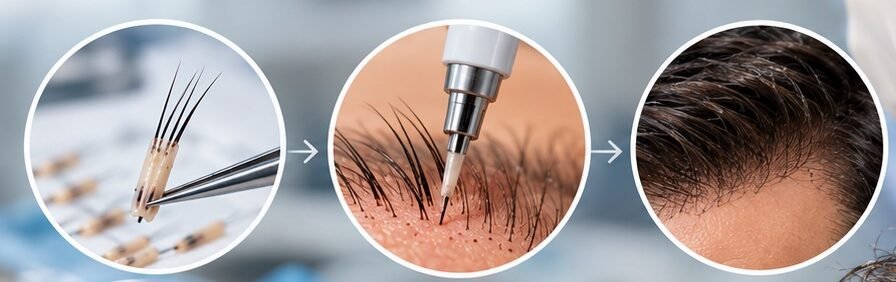
DHI stands for Direct Hair Implantation. It is a refinement of FUE — Follicular Unit Extraction — that modifies the implantation stage of the procedure using a specialized instrument called a Choi implantor pen. To understand why DHI exists, you need to understand what it changed from standard FUE.
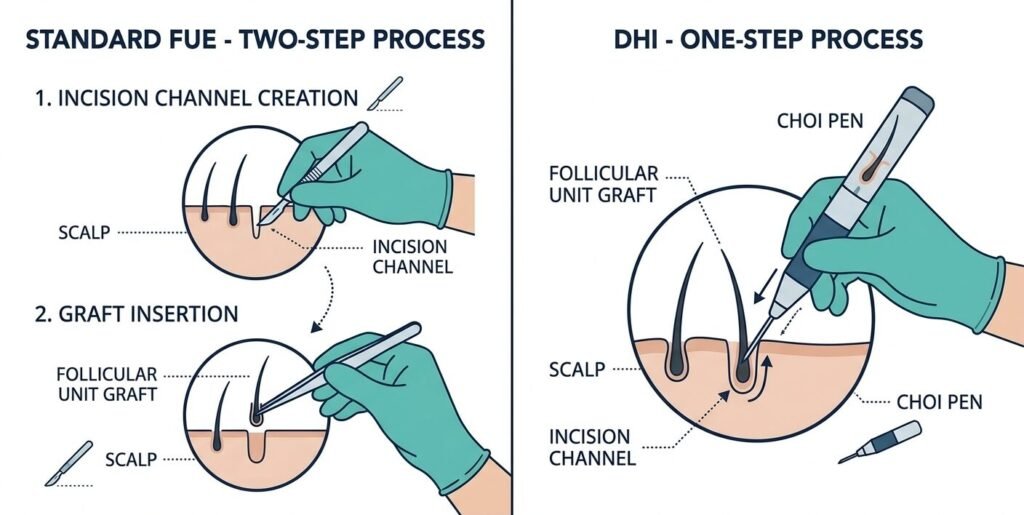
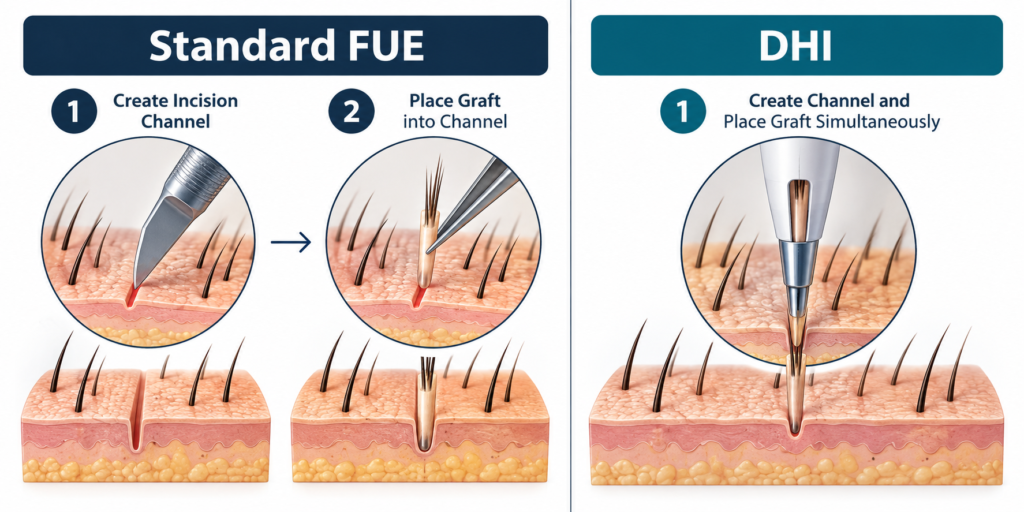
In standard FUE, the procedure has two clearly separated stages. First, the surgeon uses a fine blade to create incisions — channels — across the entire recipient area. Then, in a separate stage, the surgical team uses fine forceps to place the extracted grafts into those pre-made channels one by one.
DHI eliminates the gap between those two stages. The Choi pen is a hollow needle device that loads a single follicular unit into its tip. When pressed against the scalp, the needle simultaneously creates a channel and deposits the graft at precisely the correct depth and angle in a single motion. Channel creation and implantation happen as one continuous action.
That single technical distinction — simultaneous channel creation and implantation — is the source of every genuine advantage DHI has over standard FUE. And understanding it properly lets you evaluate whether those advantages matter for your specific case.
How the Choi Pen Works: A Technical Explanation
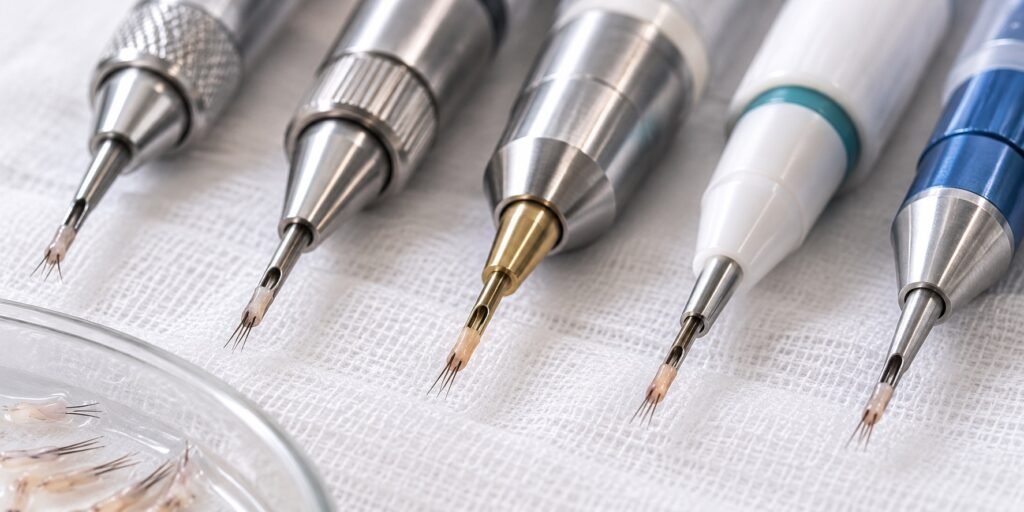
The Choi implantor pen was developed in South Korea in the 1990s — the name comes from its inventor, Dr. Choi. Modern versions are precision-machined instruments available in several sizes, typically with needle diameters ranging from 0.6mm to 1.5mm depending on the size of the graft being placed.
The mechanism is straightforward but demanding in execution. A trained implanter loads a single follicular unit into the hollow needle tip using fine forceps, orienting the root correctly so the bulb enters first and the hair emerges at the correct angle. The pen is pressed against the recipient scalp at a precise angle. A spring-loaded plunger is then depressed, driving the needle into the scalp and simultaneously ejecting the follicle at a controlled depth.
That process is repeated thousands of times over a procedure. A 2,500-graft DHI session requires 2,500 individual pen insertions, each one requiring the correct angle, the correct depth, the correct distribution, and a correctly loaded graft. The skill ceiling for DHI is significantly higher than for standard FUE implantation precisely because there is no pre-planned channel to guide placement — every decision is made in real time.
Several Choi pens are used simultaneously during a DHI procedure — typically six to twelve pens per technician, loaded in rotation so that while one is in use another is being loaded. A skilled DHI team creates a rhythm that keeps per-graft out-of-body time low and procedure pace efficient.
DHI vs FUE: The Complete Comparison
This is the most-searched question about DHI and the one with the most misleading answers online. Clinics that specialize in DHI will tell you it’s superior across the board. Clinics that specialize in FUE will tell you the opposite. Here is what the evidence and experienced practitioners actually say.
Where DHI genuinely outperforms standard FUE
Higher density per session. Because the Choi pen allows precise control over graft placement at any angle and depth without the constraints of pre-opened channels, experienced DHI surgeons can achieve marginally tighter graft distribution in a given area. This translates to higher density potential — more hairs per square centimeter in the recipient zone. For patients whose primary goal is maximum crown density or a very full hairline, DHI’s density advantage is real.
Better performance in areas with existing hair. This is arguably DHI’s most important clinical advantage. In standard FUE, the surgeon opens channels across the recipient area before implantation begins — a process that disrupts existing native hair in that zone and can trigger shock loss of surrounding follicles. The Choi pen’s precise single-insertion approach causes significantly less disruption to existing native follicles during implantation. For patients who still have meaningful coverage in the recipient area and want to add density without sacrificing what’s already there, DHI is the more appropriate technique.
Less time grafts spend outside the body. In standard FUE, channels are opened across the entire recipient zone before grafts are placed — meaning some grafts wait in holding solution while others are being positioned. With DHI, loading and implanting happen concurrently, which reduces the average out-of-body time per graft. Shorter out-of-body time correlates with better graft survival, though the magnitude of this advantage depends heavily on how well the FUE clinic manages its implantation workflow.
Potentially reduced bleeding in the recipient area. Because DHI doesn’t require pre-opening all channels before implantation, the cumulative trauma to the recipient area is slightly reduced. Some surgeons report faster recovery in DHI patients for this reason.
Where standard FUE or Sapphire FUE outperforms DHI
Higher graft counts per session. Standard FUE’s two-stage process is faster at scale. A 4,000-graft FUE procedure is logistically easier to execute than a 4,000-graft DHI procedure, where every single graft requires precise pen loading and insertion. Most DHI surgeons cap single-session graft counts at 2,500 to 3,500 for practical reasons. Patients with extensive loss needing 4,000 or more grafts are often better served by FUE or a two-session approach.
More forgiving of technical variation. Pre-opening channels gives the surgeon a visual map to follow during implantation, which provides more consistency in the hands of less experienced teams. The DHI process places higher demands on the implanting team’s skill and concentration.
Lower cost. DHI procedures typically cost 20 to 35 percent more than standard FUE at the same clinic, primarily because of the higher time investment per graft and the cost of the Choi pen instruments.
Wider availability of highly experienced practitioners. FUE has a twenty-year head start on DHI in terms of global adoption. The pool of surgeons with extensive DHI-specific experience is smaller, particularly in markets outside Turkey and South Korea.
The honest verdict
DHI is a genuinely superior technique in specific circumstances: high-density work in a limited area, hairline refinement in zones with existing hair, and crown restoration where every additional hair per square centimeter matters. For patients needing large-scale coverage — first-time procedures with extensive loss requiring 3,500 or more grafts — standard FUE or Sapphire FUE is often the more practical choice, and outcomes are comparable.
The technique is a tool. The surgeon’s skill with that tool is what produces your result.
DHI vs Sapphire FUE: Which One Is Better?
This comparison gets less attention than DHI vs FUE, but it’s often the more relevant question for patients at premium Istanbul clinics where both are commonly offered.
Sapphire FUE is standard FUE with sapphire-tipped blades replacing steel for the channel-opening stage. It produces smaller, cleaner incisions with less tissue trauma — faster healing and marginally better density in the recipient zone compared to standard steel FUE. But it remains a two-stage process: channels first, implantation second. DHI eliminates that separation entirely.
For the recipient area, DHI’s one-step process reduces cumulative tissue trauma beyond what even Sapphire FUE achieves. For density in targeted zones and for procedures in areas with existing hair, DHI holds an edge over Sapphire FUE.
For large surface area coverage, Sapphire FUE’s ability to pre-plan and pre-open channels systematically across a large zone before implantation gives it an organizational efficiency advantage. A 4,000-graft Sapphire FUE procedure is more logistically straightforward than the equivalent in DHI.
Many premium Istanbul clinics have developed hybrid approaches — using Sapphire FUE for extraction and recipient site creation in larger coverage areas, then switching to DHI-style Choi pen implantation in targeted high-density zones like the hairline and crown. This hybrid approach captures the advantages of both techniques for the right anatomical zones.
The DHI Procedure: Step by Step
The DHI procedure follows the same general structure as FUE for the extraction stage, then diverges in how implantation is performed.
Before the Procedure
A proper DHI consultation includes the same elements as any hair transplant assessment: trichoscopy of donor density, mapping of the recipient zone, hairline design, discussion of graft count, and a realistic conversation about what DHI specifically can achieve versus standard FUE for your case. If a surgeon recommends DHI without explaining why it’s specifically better for your situation, that’s worth probing.
Preparation and Anesthesia
The donor area is shaved and local anesthesia administered — the same process as standard FUE. The recipient area preparation differs slightly: because DHI doesn’t require pre-opening all channels, the recipient zone doesn’t need to be as extensively marked in advance, though hairline design is still mapped and marked carefully before beginning.
Extraction
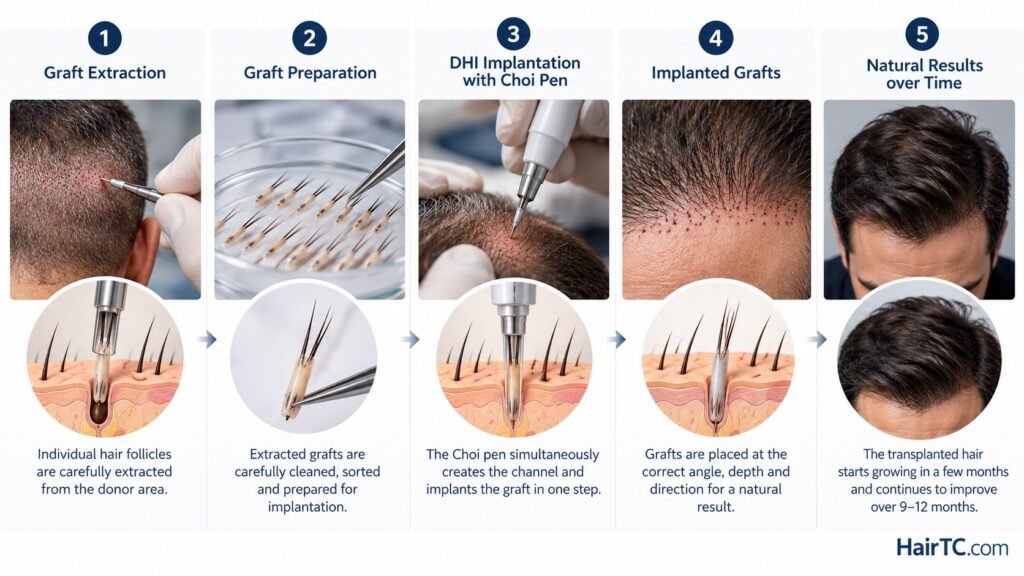
DHI uses the same FUE punch extraction as standard FUE — individual follicular units are scored and removed from the donor area using a circular punch tool at 0.6mm to 0.9mm diameter. This stage is identical in both techniques. The difference is entirely in what happens to those grafts once extracted.
Loading and Implantation
As grafts are extracted and sorted, the implanting team begins loading them into Choi pens in rotation. Each graft is carefully loaded into the needle tip with the bulb oriented correctly. The implanter then works across the recipient area, pressing the pen to the scalp at the appropriate angle, inserting to the correct depth, and depressing the plunger to deposit the graft.
Good DHI teams develop a loading rhythm where multiple pens cycle simultaneously — one pen inserting while others are being loaded — minimizing the time any individual graft spends outside the body waiting to be placed.
This stage requires high concentration sustained across thousands of insertions. Fatigue management is a genuine quality concern in DHI for large graft counts, which is why experienced clinics cap DHI sessions at lower graft counts than FUE.
Post-Procedure
Recovery after DHI is comparable to standard FUE, with one frequently noted difference: many patients report less swelling and faster scab resolution in the recipient area. This is consistent with DHI’s lower cumulative tissue trauma at the implantation stage. The donor area heals identically to standard FUE — tiny circular extraction points that resolve within seven to ten days.
Post-operative care instructions are the same: elevated sleep position for the first few nights, gentle washing protocol starting the day after the procedure, activity restrictions for four to six weeks.
DHI Recovery: What to Expect Week by Week
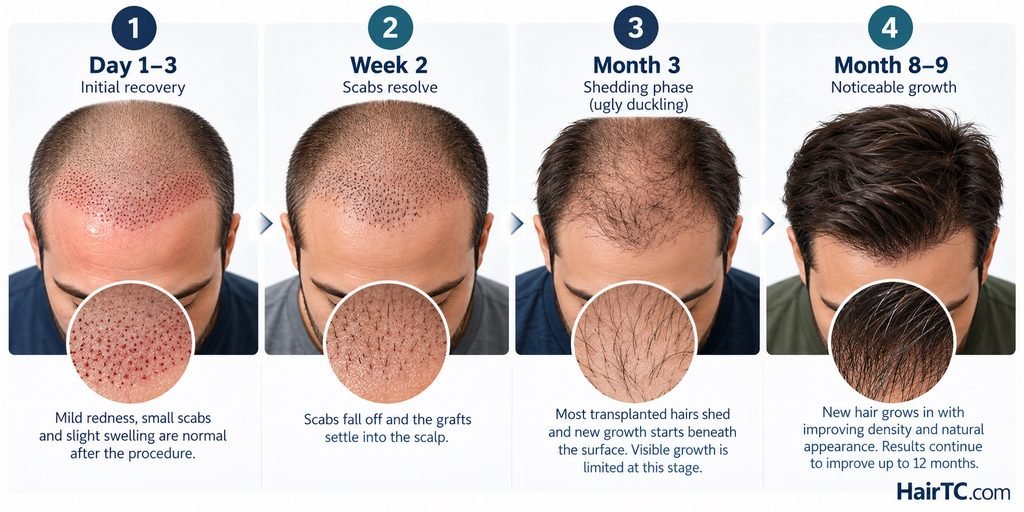
Days 1 to 3: Mild swelling in the forehead is normal and peaks around day two to three. The recipient area shows the tiny implanted graft stubs across the treated zone. Sleep elevated to minimize fluid migration downward.
Days 4 to 10: Scabs form and begin to soften through the washing protocol. The donor area heals quickly. Many DHI patients note less crusting in the recipient zone than they expected — consistent with the reduced tissue trauma of the technique.
Weeks 2 to 4: Scabs have largely resolved. The grafts are anchored and vascularizing. Activity restrictions remain important even though the scalp looks calm.
Month 1 to 2: Shock loss arrives — the transplanted hair shafts shed as follicles enter a resting phase. This is biologically identical in DHI and FUE. The follicle root survives and will regrow. It is alarming the first time you see it and completely expected.
Month 3: The ugly duckling phase. Growth is minimal or just beginning. Patchiness is normal. This is the most psychologically testing period regardless of technique.
Month 4 to 6: New growth emerges and accelerates. DHI procedures in the hairline and crown zones often show particularly pleasing early results because the density work that DHI enabled becomes visible as the first hairs thicken.
Month 6 to 12: The DHI advantage in density becomes most apparent at this stage for patients who had crown or hairline-focused work. The higher grafts-per-square-centimeter achievable with DHI translates to noticeably fuller coverage in targeted zones compared to what standard FUE typically produces.
Month 12 to 18: Final maturation. Hair thickens, late follicles activate, texture normalizes.
DHI Results: Before and After What’s Realistic
DHI’s specific result advantages are most pronounced in three scenarios that the technique was designed to address.
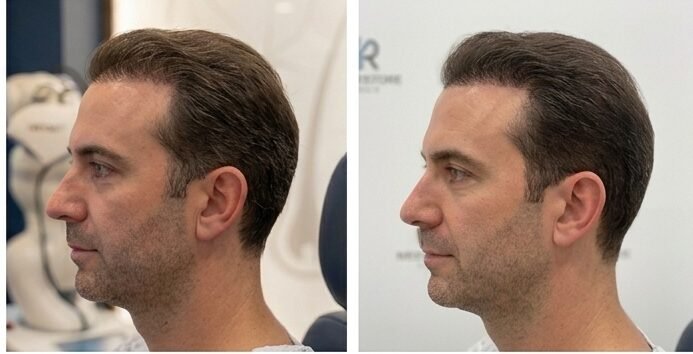
High-density hairline results. Because DHI achieves tighter graft distribution than standard FUE in the hairline zone, the front hairline typically shows higher density at equivalent graft counts. The single-hair follicular units placed in the very front rows of a DHI hairline are positioned with more precision than pre-made channels allow, producing a softer, more graduated natural transition.
Crown restoration. The crown is one of the most challenging areas to treat because of its circular whorl pattern and the high density required to produce a visually full result. DHI’s graft placement precision makes it particularly effective for crown work. Results at months six to twelve in crown-focused DHI procedures often show better fill than equivalent standard FUE crown work.
Adding density to existing hair. This is where DHI is most clearly superior — adding density to a zone that already has meaningful native hair coverage. Because DHI doesn’t require pre-opening channels across the entire zone (which would disrupt existing follicles), the procedure can be performed more precisely within and around existing hair without significantly triggering shock loss of those follicles. Before-and-after documentation for this type of case shows existing hair preserved and new growth seamlessly added.
What DHI cannot do: DHI cannot create density from nothing when donor supply is insufficient. It cannot restore hair to zones where there is zero remaining follicular activity. It cannot produce results beyond what the donor graft count allows, regardless of how precisely each graft is placed.
DHI Hair Transplant Cost in 2026
DHI commands a premium over standard FUE consistently across all markets, reflecting the higher time investment per graft, the cost of Choi pen instruments (which are single-use or require frequent replacement), and the higher skill demands on the implanting team.
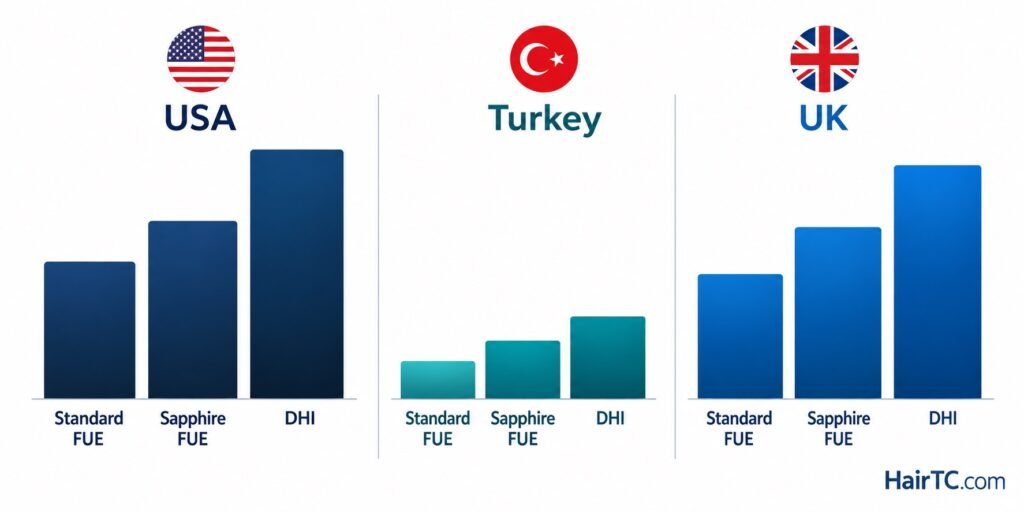
United States: DHI at US clinics typically runs $8,000 to $18,000 for mid-range graft counts (1,500 to 3,000 grafts). Premium specialist practices charge $15,000 to $25,000 for DHI procedures. Add $1,500 to $3,000 in ancillary costs (pre-op tests, medication, PRP, follow-up) for total out-of-pocket.
Turkey — Istanbul: All-inclusive DHI packages at accredited Istanbul clinics run €3,200 to €5,000 (~$3,520 to $5,500) depending on graft count, hotel tier, and included services. This covers the procedure, hotel, transfers, medication, and follow-up support. The premium over standard FUE packages in Istanbul is typically €400 to €800 (~$440 to $880).
For US patients traveling to Istanbul for DHI, total cost including flights runs approximately $4,700 to $6,800 — compared to $10,000 to $20,000 domestically. The saving of $5,000 to $13,000 makes Istanbul the overwhelmingly practical choice for most patients purely on economics.
UK: DHI at UK accredited clinics typically runs £6,000 to £12,000. Istanbul all-inclusive DHI at approximately €3,500 to €4,800 (~£3,000 to £4,100) plus flights (£180 to £380) brings the total to roughly £3,200 to £4,500 — a saving of £1,500 to £7,500 versus domestic.
What drives the DHI premium within a market: Choi pens are consumable instruments that must be replaced frequently to maintain needle sharpness. A dull Choi pen needle creates unnecessary trauma during insertion — so quality clinics replace them regularly throughout a procedure. This consumable cost contributes meaningfully to DHI pricing versus standard FUE.
DHI in Turkey: Why Turkey Dominates DHI
Turkey, and Istanbul specifically, has a unique position in the global DHI market. Istanbul clinics collectively perform more DHI procedures annually than any other country — by a significant margin. Several factors explain this.
Turkey was an early adopter of DHI when the technique began gaining international recognition, and several Istanbul clinics invested heavily in Choi pen technique training before it became mainstream elsewhere. Surgeons like those at Smile Hair Clinic and Cosmedica developed DHI-specific expertise at a scale — and a per-surgeon case volume — that surgeons in lower-volume Western markets simply haven’t matched.
The economics reinforce the volume advantage. An Istanbul DHI specialist performing four to five procedures per week builds a clinical skill base in three years that a US surgeon operating at one or two procedures per week accumulates over a decade. Raw case volume is not a proxy for quality — but beyond a baseline of competence, surgical skill in DHI is genuinely sharpened by repetition.
Istanbul also has the accreditation infrastructure to support DHI at scale. Several JCI-accredited facilities and TEMOS-certified clinics now specifically advertise DHI as their primary technique. The competitive market between Istanbul DHI clinics has driven up quality standards — poor outcomes are visible on forums and damage bookings in a way that creates genuine commercial pressure toward quality.
For patients specifically seeking DHI, the Istanbul market combines the deepest pool of experienced DHI practitioners with the the lowest cost in the world for the technique. The due diligence required is identical to any Turkish clinic selection — verify accreditation, confirm surgeon involvement, read reviews at scale — but the reward for doing that research properly is substantial.
Who Is a Good Candidate for DHI?
DHI is the right technique in specific circumstances. Understanding those circumstances helps you evaluate your surgeon’s recommendation honestly.
Ideal DHI candidates:
Patients whose primary goal is high density in a defined zone — hairline refinement, crown restoration, temple reconstruction — rather than broad coverage across a large area. The density advantage DHI offers is most valuable when it’s concentrated.
Patients with meaningful existing hair in the recipient zone who need supplementation without risking existing coverage. DHI’s reduced disruption to surrounding follicles during implantation makes it the conservative choice for working in areas with live native hair.
Patients with good donor density who need precise, high-quality work on a first procedure and are willing to pay the premium for the technique’s advantages.
Patients considering a second procedure to add density to a previously transplanted area — the precision of DHI makes it well suited for layering additional grafts into an existing result.
Cases where DHI is less appropriate:
Patients with extensive hair loss requiring 4,000 or more grafts in a single session. The practical limitations of DHI at high graft counts (slower pace, higher cost, fatigue risk) make FUE or Sapphire FUE the more strategic choice.
Patients primarily concerned with cost. If budget is a significant constraint, the DHI premium is not justified for broad coverage work where standard FUE produces comparable outcomes.
Patients at clinics where the DHI team lacks extensive case experience. The technique’s demands mean a mediocre DHI result is more likely to fall short than a mediocre FUE result — the skill ceiling is higher, which means the floor for poor execution is also more consequential.
How to Evaluate a DHI Clinic and Surgeon
The criteria for evaluating a DHI practice follow the same framework as any hair transplant clinic — with several DHI-specific additions.
Verify the surgeon’s DHI-specific experience. Ask how many DHI procedures the surgeon and their team perform per month, and how many they have performed in total. DHI requires more repetition to master than standard FUE. A team performing five DHI procedures a month has materially different skill levels than one performing fifty.
Ask about their Choi pen replacement protocol. A quality DHI clinic replaces Choi pens frequently during a procedure — typically after every 150 to 200 insertions — to maintain needle sharpness. Ask directly how often they replace pens during a procedure. Inability or unwillingness to answer this question tells you something.
Ask how many pens are used per implanter and how loading is organized. A skilled DHI team uses six to twelve pens per implanter in rotation with loading assistants maintaining a continuous supply of loaded pens. A disorganized loading process creates long graft out-of-body times that damage survival rates.
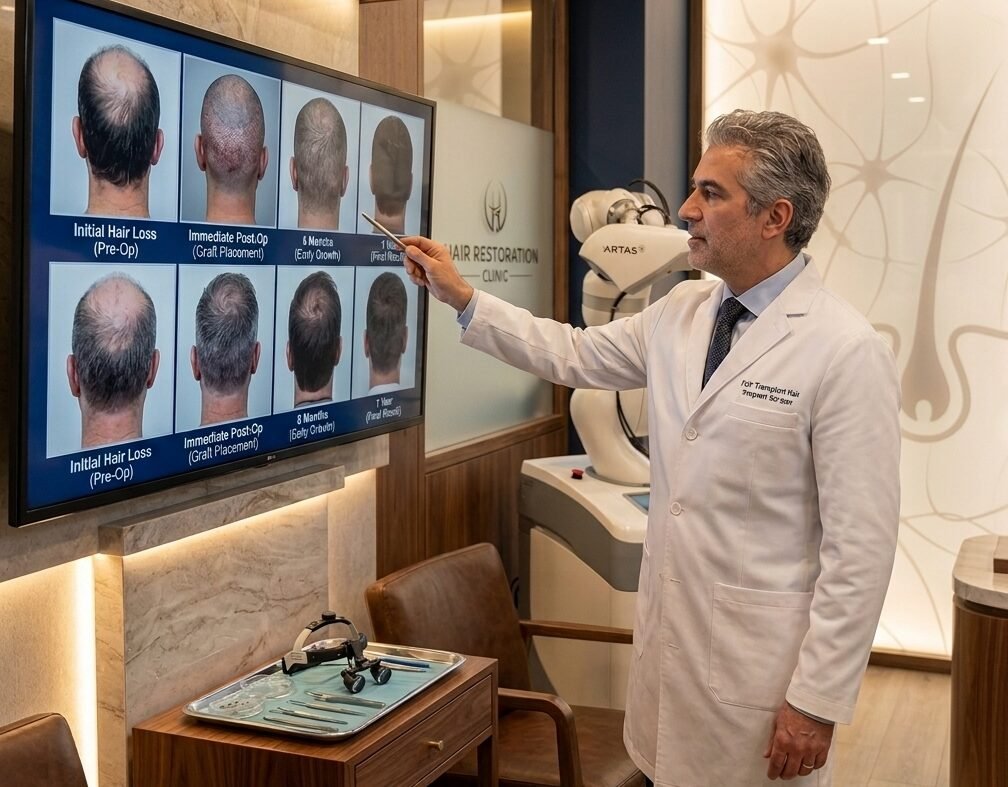
Request DHI-specific before-and-after documentation. Don’t accept a clinic’s general before-and-after library as evidence of DHI capability. Ask specifically for DHI cases — matched to your hair type, loss pattern, and target area — that show results at multiple time points including month six and month twelve.
Confirm who performs implantation. In many high-volume clinics, technicians load and operate the Choi pens while the surgeon’s role is limited to hairline design and supervision. This is the critical quality variable in DHI specifically. Surgeon-performed DHI implantation produces better outcomes in most documented comparisons with technician-led DHI. Know what you’re paying for.
Frequently Asked Questions
What is DHI hair transplant? DHI (Direct Hair Implantation) is a hair transplant technique that uses a specialized device called a Choi implantor pen to extract and implant hair follicles in one simultaneous motion. Unlike standard FUE, which opens all recipient channels before implantation begins, DHI combines those stages — the pen creates the channel and deposits the follicle in a single insertion. This allows higher density, less trauma to existing hair, and potentially better graft survival.
What is the difference between DHI and FUE hair transplant? The extraction stage is identical in both — individual follicles are removed from the donor area using a circular punch. The difference is entirely in implantation. Standard FUE pre-opens all recipient channels before placing grafts. DHI uses a Choi pen to simultaneously create each channel and implant the follicle. DHI allows higher density per session in targeted areas and causes less disruption to existing native hair. Standard FUE is faster at high graft counts and lower in cost.
Is DHI better than FUE? DHI is better than standard FUE in specific circumstances: high-density crown or hairline work, adding density to areas with existing hair, and cases where maximum precision per graft matters. For large-scale coverage requiring 3,500 or more grafts in one session, standard FUE or Sapphire FUE is usually the more practical choice. Neither technique is universally superior — the right choice depends on your specific case and goals.
How much does DHI hair transplant cost? In the US, DHI ranges from $8,000 to $25,000 depending on graft count and clinic tier. In Istanbul, accredited all-inclusive DHI packages run €3,200 to €5,000 (~$3,520 to $5,500). The DHI premium over standard FUE is typically 20 to 35 percent at any given clinic.
Is DHI more painful than FUE? No. Both techniques use local anesthesia and the patient experience during the procedure is broadly comparable — pressure and vibration are felt during extraction, but no pain once anesthesia takes effect. Some patients report slightly faster healing in the recipient area after DHI due to reduced tissue trauma at implantation.
What does DHI recovery look like? Recovery follows the same timeline as FUE: scabs resolve in one to two weeks, shock loss occurs in weeks three to eight, the ugly duckling phase at month three, early growth from month four to five, good density by month nine to twelve, and final results at eighteen months. DHI patients sometimes report faster resolution of recipient area scabbing due to the reduced trauma of the Choi pen implantation.
How many grafts can be done with DHI? Most DHI procedures are capped at 2,500 to 3,500 grafts per session for practical reasons — the Choi pen process is slower per graft than pre-opened channel implantation, and fatigue management becomes a concern at high graft counts. Patients needing 4,000 or more grafts are often better served by FUE or a two-day session split.
Is DHI available in Turkey? Yes — Istanbul is arguably the global center of DHI expertise. Several accredited Istanbul clinics specialize in DHI and perform more procedures annually than most other countries combined. Istanbul DHI packages run €3,200 to €5,000 (~$3,520 to $5,500) all-inclusive — dramatically lower than equivalent US or UK pricing.
What is the Choi pen and why does it matter? The Choi implantor pen is the instrument that defines DHI. It’s a hollow needle device that holds a single follicular unit at its tip. When pressed against the scalp, it simultaneously creates a micro-channel and deposits the follicle at the correct depth and angle in one motion. The quality and sharpness of the Choi pen directly affects the precision and tissue trauma of the implantation. Clinics that replace pens frequently during a procedure (every 150 to 200 insertions) produce better outcomes than those that use pens past their optimal sharpness.
Does DHI leave scars? The donor area heals identically to standard FUE — tiny circular extraction points that are invisible at normal hair lengths. The recipient area has no incision sites in the conventional sense; the Choi pen’s micro-insertions heal quickly with minimal residual marking.
The Bottom Line on DHI
DHI is a genuinely advanced hair transplant technique with specific, real advantages over standard FUE in the right circumstances. The higher density potential, the reduced disruption to existing hair, and the precision of Choi pen implantation are not marketing claims — they’re documented clinical advantages that experienced DHI practitioners achieve consistently.
The conditions that apply: DHI’s advantages are most pronounced when performed by surgeons and teams with extensive DHI-specific case volumes. The technique’s demands mean that DHI in mediocre hands can produce worse results than FUE in good hands. The premium is justified when the surgeon and team genuinely have the DHI experience to realize the technique’s potential.
For patients with the right case profile — targeted density work, areas with existing hair, hairline refinement — DHI is worth the premium. For patients who need broad coverage at high graft counts, FUE or Sapphire FUE typically offers better value. The conversation starts with your surgeon, not the technique name.
Istanbul, for patients open to international travel, gives you access to the most experienced DHI practitioners in the world at a fraction of domestic pricing. That combination of expertise and cost efficiency is the reason thousands of patients fly specifically to Istanbul for DHI every month.
Technical information in this guide is based on published clinical literature and documented surgical practice as of early 2026. Individual results vary based on donor characteristics, surgeon skill, graft count, and post-operative care. Euro/dollar conversions use approximate early 2026 rates (~1.10 EUR/USD). hairtc.com is an independent editorial resource. We do not accept payment from clinics for coverage.