
FUE HAIR TRANSPLANT
FUE is now the dominant hair transplant technique worldwide, and for most patients it’s the right starting point for any conversation about surgical hair restoration. But the term “FUE” has expanded significantly since it was first developed — Sapphire FUE, No Shave FUE, motorized FUE, robotic FUE, and DHI all sit under the same broad umbrella, and understanding what separates them matters before you sit in a consultation chair.
This guide covers all of it. What FUE is, how it actually works step by step, what makes it different from FUT and DHI, what Sapphire FUE and NeoGraft and ARTAS actually mean in practice, how much it costs, what results look like over time, and the questions you need answered before choosing a surgeon.

What Is FUE? The Simple Explanation
FUE stands for Follicular Unit Extraction. It’s a surgical hair transplant technique where individual hair follicles — typically containing one to four hairs each — are extracted one at a time from a donor area (usually the back and sides of the scalp) and implanted into the thinning or bald areas.
The defining characteristic of FUE is how those follicles are removed. A small circular punch tool, typically 0.6mm to 1.0mm in diameter, creates a microscopic incision around each follicular unit before extraction. Because each follicle is removed individually rather than as part of a strip of tissue, FUE leaves no linear scar — just tiny circular marks that become invisible at normal hair lengths.
That single distinction — no linear scar — is what drove FUE to overtake FUT (strip surgery) as the global standard over the past fifteen years. Patients can wear short hair styles without worrying about a visible scar at the back of the head, recovery is faster, and the procedure is less invasive.
What FUE doesn’t change is the fundamental biology. Whether you have FUE, FUT, or DHI, the transplanted follicles go through the same shock loss phase, the same growth timeline, and the same permanent result. The technique affects the extraction method, the recovery experience, the scar profile, and in some cases the maximum graft count available per session — not the underlying biology of hair growth.
FUE Procedure Step by Step:
Understanding each stage helps set realistic expectations for what the procedure day looks like and why it takes as long as it does.
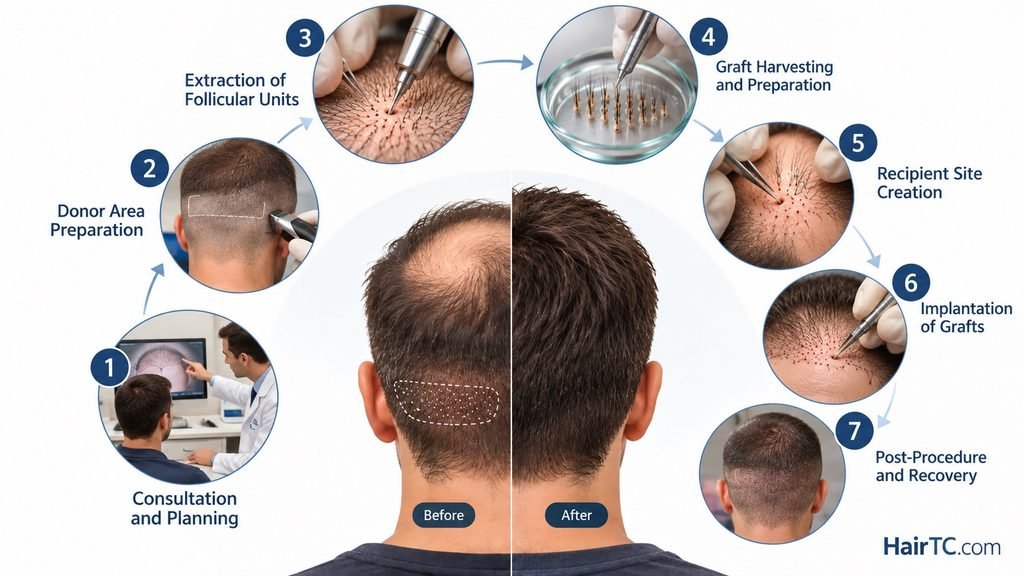
Stage 1: Consultation and Planning
Before the procedure itself, a proper FUE consultation involves a physical examination of your scalp — both the donor area and the recipient zone. The surgeon assesses donor density using trichoscopy or digital magnification, maps out your hair loss pattern, discusses your family history and likely future progression, and designs a hairline appropriate for your facial structure and age.
The graft count is determined based on donor density, the area to be covered, and the density target. Good surgeons are conservative with donor supply — over-harvesting to achieve an aggressive result in one session can leave you without adequate donor hair for future sessions if your loss continues.
Stage 2: Donor Area Preparation
On procedure day, the donor area — typically the occipital and parietal regions of the scalp — is shaved to approximately 1mm length. This allows the surgeon to see individual follicular units clearly during extraction. In No Shave FUE (discussed separately below), this step is modified.
Local anesthesia is administered to the donor area. This is the most uncomfortable part of the procedure for most patients — a series of small injections that create temporary stinging before the area becomes completely numb. After the anesthesia takes effect, patients typically feel pressure and vibration during extraction but no pain.
Stage 3: Extraction of Follicular Units
The surgeon — or, at lower-tier operations, a technician — uses the punch tool to score around each follicular unit. The graft is then extracted with forceps and placed immediately into a holding solution to preserve viability while the extraction phase continues.
This stage takes several hours for larger graft counts. A 3,000-graft procedure typically requires four to six hours for extraction depending on the surgeon’s pace and the technique being used. During this time, patients are reclined in a comfortable chair and can watch a screen, listen to music, or sleep.
The transection rate — how many grafts are accidentally damaged during extraction — is the key quality metric at this stage. Experienced surgeons using sharp instruments at appropriate punch sizes typically achieve transection rates of 3 to 8 percent. Rates above 15 percent represent significant graft loss that directly impacts your result.
Stage 4: Graft Sorting and Preparation
Extracted grafts are examined under magnification by the surgical team. Single-hair grafts are separated from two-hair and three-hair units — single-hair follicles go to the hairline for a natural soft transition; multi-hair units go to the mid-scalp and crown for density.
Quality clinics use hypothermic storage solutions to preserve graft viability during this stage. The time grafts spend outside the body — the out-of-body time — directly affects survival rates. Well-organized clinics minimize this time through simultaneous extraction and sorting rather than completing all extraction before beginning implantation.
Stage 5: Recipient Site Creation
The surgeon creates tiny incisions in the recipient area — the thinning or bald zones — into which the grafts will be placed. The size, angle, and depth of these incisions determine the growth direction, the density achievable, and critically, how natural the result looks.
This is the most artistically demanding stage of the procedure. Hairline design — the placement pattern of single-hair follicles in the front row — requires genuine aesthetic judgment about what will look natural for your face, your age, and how your hair loss might progress over the next decade. It cannot be rushed and cannot be corrected without another procedure.
In standard FUE, the channel opening and implantation are two separate steps. In DHI (discussed below), they are combined using a specialized device. In Sapphire FUE (also below), the channel-opening stage uses sapphire rather than steel blades.
Stage 6: Implantation of Grafts
Grafts are placed into the prepared channels using fine forceps or an implantor pen. Single-hair grafts go at the hairline; denser multi-hair units fill the mid-scalp and crown. The implanting surgeon or technician controls the depth and angle of each graft during placement — consistency at this stage determines the uniform growth direction that makes a result look naturally integrated.
A 3,000-graft implantation session typically takes two to four hours after extraction is complete. Total procedure time for a 3,000-graft FUE is usually eight to twelve hours, sometimes spread across two days for larger counts.
Stage 7: Post-Procedure
The recipient area is left unbandaged in most FUE protocols — or covered with a light protective layer at some clinics. The donor area is cleaned and may be covered briefly. Patients leave the clinic the same day.
The first clinical hair wash, performed by nursing staff, typically happens the morning after the procedure. Post-operative care instructions — how to wash, what to avoid, what to apply — are the patient’s responsibility from that point forward and significantly affect graft survival rates.
FUE vs FUT: The Real Differences in 2026
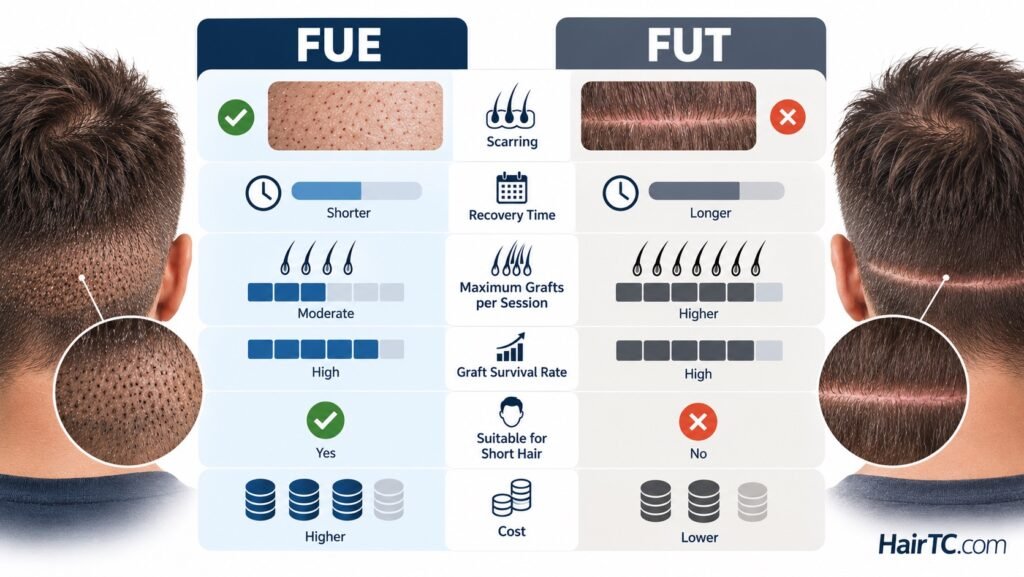
The FUE versus FUT debate has been largely settled by patient preference — FUE is now performed at approximately 80 to 90 percent of hair transplant procedures globally. But FUT retains genuine advantages in specific situations, and understanding those helps you have a more informed conversation with your surgeon.
Scarring: FUE leaves tiny circular scars — 0.6mm to 1.0mm each — distributed across the donor area. At normal hair lengths they’re invisible. At skin-level shaving they’re visible as small white dots. FUT leaves a single linear scar across the back of the scalp, which can be covered by hair grown to half an inch or longer but is visible at shorter lengths. For patients who want to wear very short back-and-sides, FUE is the unambiguous choice.
Graft count per session: FUT can yield a higher graft count in a single session because the strip yields a larger number of follicles from a smaller total donor area impact. For patients with extensive loss requiring 5,000 or more grafts who have good laxity in the scalp skin, FUT may allow a larger single-session yield. FUE’s per-session limit is typically 3,000 to 4,000 grafts at most clinics before donor depletion becomes a concern.
Graft survival: Marginally higher for FUT in studies, because grafts removed with their surrounding tissue intact are less vulnerable to transection. In practice, at experienced surgeon practices with low transection rates, the difference in outcome is minimal.
Recovery: Faster with FUE. No stitches, no linear wound, no restriction on neck movement. FUT patients typically need ten to fourteen days before the donor area feels comfortable again and sutures are removed. FUE patients are usually back to desk work within a few days.
Future flexibility: FUE preserves more donor area flexibility for future sessions because extraction is distributed rather than concentrated in one strip. This matters for younger patients or those with progressive loss who may need additional procedures later.
Cost: FUT is typically 10 to 20 percent less expensive than FUE at the same clinic because it’s faster to perform. The cost difference is narrower than it once was as FUE has become the dominant technique and per-graft rates have converged.
When FUT is still the right choice: Patients needing very high graft counts (5,000+) in a single session, patients who plan to always wear hair long enough to cover a linear scar, and patients for whom donor supply is genuinely limited may find FUT offers a better strategic outcome. The conversation is worth having with your surgeon rather than assuming FUE is always superior.
FUE vs DHI: What’s the Actual Difference?
DHI — Direct Hair Implantation — is frequently marketed as a premium upgrade to FUE. Understanding what it actually is versus what the marketing says helps you evaluate whether it’s worth the higher price for your case.
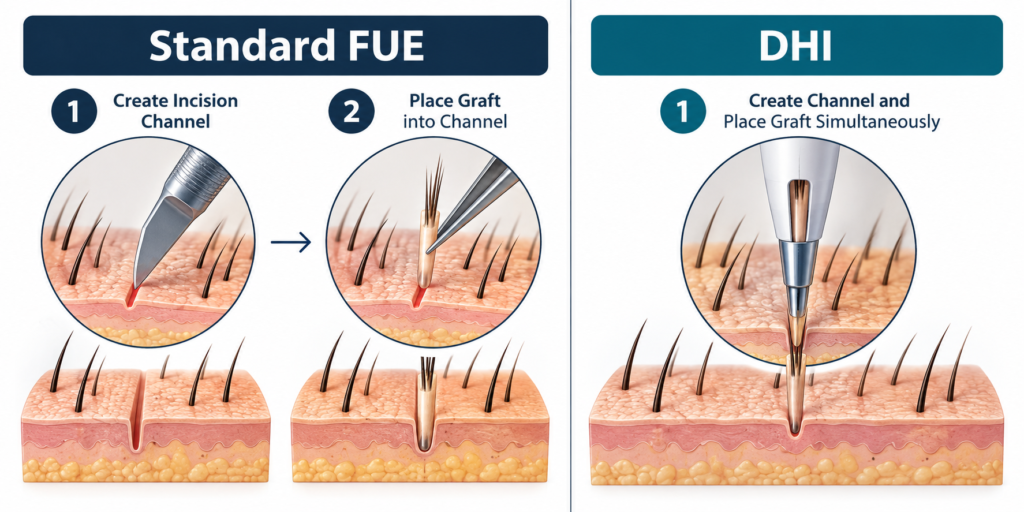
IMAGE: prompt — A detailed medical illustration showing the DHI Choi pen device in use. The pen is a small cylindrical instrument with a hollow needle tip. The illustration shows a hair follicle being loaded into the Choi pen from above, then the pen being pressed against the scalp to simultaneously create a channel and implant the follicle in one motion. Clean technical illustration style, navy and teal palette, white background. Compare this to a standard FUE implantation shown adjacent — forceps placing a graft into a pre-made channel — to show the process difference clearly.
In standard FUE, the process has two distinct stages: first the surgeon creates all the recipient channels (the incisions into which grafts will be placed), then the team implants the grafts into those pre-made channels.
In DHI, a specialized device called a Choi implantor pen combines these stages. The follicle is loaded into the pen, which simultaneously creates the channel and places the graft in a single motion. There is no pre-opening of channels before implantation begins.
The genuine advantages of DHI:
Higher density potential per session, because the Choi pen’s precise depth and angle control allows grafts to be placed more closely together than pre-made channels typically allow. This makes DHI particularly useful for crown work and hairline refinement where maximum density is the priority.
Less handling time per graft, which can improve survival rates — though the evidence on this is mixed and highly dependent on surgeon skill.
Better suited for implanting into areas that still have existing native hair, because the Choi pen doesn’t require the surrounding area to be shaved as extensively and causes less disruption to existing follicles.
The limitations of DHI:
More technically demanding, meaning the quality variation between a skilled DHI surgeon and an inexperienced one is more pronounced than with standard FUE. The benefit of the technique is only realized with a skilled practitioner.
Slower extraction and implantation pace, which means DHI procedures typically take longer than equivalent FUE cases. This limits the graft count achievable per session.
Higher cost — typically 20 to 35 percent more than standard FUE — which is not always justified by outcome differences for straightforward hairline cases.
When DHI is worth it: Crown density work, hairline refinement in areas with existing hair, and cases where maximum density is the primary goal. For a first-time patient with significant loss needing high graft counts, standard FUE or Sapphire FUE often makes more strategic sense.
Sapphire FUE: Is It Worth the Premium?
Sapphire FUE is standard FUE with one modification: the blades used for the recipient site creation stage are tipped with synthetic sapphire rather than standard surgical steel.
The clinical case for sapphire blades is real, if modest. Sapphire is harder than steel and maintains a sharper edge for longer during the procedure, producing V-shaped micro-incisions rather than the slightly wider slits created by steel blades. The documented advantages are slightly smaller incisions, marginally less tissue trauma, faster healing in the recipient area, and potentially marginally better graft survival due to reduced trauma.
In practice, the difference in outcome between Sapphire FUE and skillfully performed standard FUE at an experienced clinic is not dramatic. What sapphire blades do more reliably is reduce recipient area swelling and accelerate the healing timeline — which patients notice as a practical post-operative difference even if the final result is comparable.
The premium at Turkish clinics is typically €300 to €600 (~$330 to $660) over standard FUE. At US clinics, it’s often included within a broader FUE package or charged as a $500 to $1,500 add-on. Many Istanbul clinics now include Sapphire FUE as their standard technique without surcharge.
Is it worth choosing specifically for Sapphire FUE over a surgeon with better credentials offering standard FUE? No. Surgeon skill matters far more than blade material. Is it worth accepting when offered at minimal premium at a clinic you’ve already vetted? Yes.

No Shave FUE: Who It’s For and What It Involves
No Shave FUE — also called unshaven FUE or long hair FUE — modifies the standard preparation to avoid shaving the donor or recipient area down to stubble. Instead, the surgeon trims individual donor follicles locally while leaving surrounding hair at its natural length, and implants into the recipient area without fully shaving that zone.
The appeal is obvious: you can have a hair transplant without the characteristic shaved appearance that makes the procedure visible to anyone who looks at the back of your head in the weeks following surgery.
The trade-offs are real. The procedure takes significantly longer because the surgeon must work around existing hair rather than with clear visibility across a shaved field. Technical difficulty is higher, which makes the quality of No Shave FUE more dependent on surgeon experience than standard FUE. Graft counts are typically lower per session because efficiency is reduced. And the cost premium is substantial — typically 30 to 50 percent more than standard FUE.
No Shave FUE is most appropriate for: Patients in professional or public-facing roles where the appearance of a shaved scalp is genuinely problematic. Women undergoing hair transplants, for whom a fully shaved donor area is often unacceptable. Patients requiring smaller, targeted sessions — hairline refinement, scar correction — rather than large-scale coverage work.
For patients with extensive loss who need high graft counts, the practical limitations of No Shave FUE (lower per-session yield, higher cost, longer procedure time) usually make standard FUE the better strategic choice.

NeoGraft and ARTAS: What the Brand Names Actually Mean
Two brand names come up constantly in US FUE marketing. Here’s the honest assessment of both.
NeoGraft
NeoGraft is a motorized FUE device that uses pneumatic suction to assist with graft extraction — instead of the surgeon manually extracting each follicle with forceps after scoring, the device applies gentle suction to draw the graft out after the punch creates the incision.
It is a legitimate FUE tool. The extraction process is faster than fully manual FUE in many cases, which reduces procedure time for large graft counts. The grafts are captured into a collection chamber which keeps them organized and reduces handling.
What NeoGraft is not: a superior technique that produces better outcomes than skilled manual FUE. The device is only as good as the surgeon operating it. Several US clinics market NeoGraft heavily as a premium differentiator and charge correspondingly higher prices. The honest framing is that it’s one approach to FUE — faster in some cases, less tactile feedback for the surgeon in others. It doesn’t eliminate the importance of surgeon skill or justify a dramatic price premium over equivalent manual FUE.
ARTAS Robotic Hair Transplant
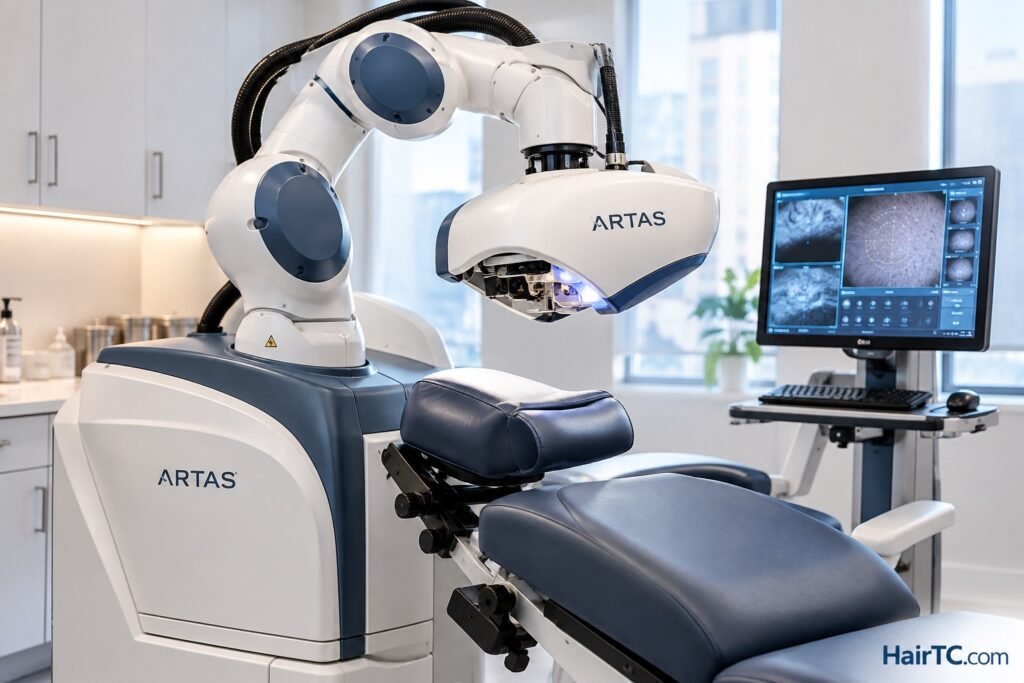
ARTAS is an FDA-cleared robotic system that uses imaging and robotics to identify and score individual follicular units during extraction. The robot maps the scalp in real time, determines optimal extraction angles and locations to avoid over-depletion, and scores the punch incision automatically. The surgeon then extracts the graft manually or using pneumatic assistance.
ARTAS represents genuine technology. The real-time donor mapping is sophisticated and the consistency of punch depth and angle during extraction is measurably high. For surgeons performing very high volume procedures, the robot’s consistency may reduce the fatigue-related quality variation that affects manual extraction over long sessions.
The cost premium is substantial — ARTAS procedures typically run $12,000 to $22,000 in the US. Clinical outcome studies show results comparable to skilled manual FUE, not meaningfully superior. The primary value of ARTAS may be consistency across very large graft counts rather than outcome superiority for typical cases.
For most patients, an experienced surgeon with manual FUE technique at a lower price point represents better value than ARTAS at the premium end — unless your specific case involves very high graft counts where the robotic consistency is most relevant.
FUE Hair Transplant Results: What to Realistically Expect
Results from FUE follow the same biological timeline as any hair transplant technique — because the technique affects extraction and implantation, not the growth cycle of the follicle after it’s transplanted.
The general framework: shock loss in weeks three to eight, ugly duckling phase at month three, early growth visible from month four to five, approximately 50 to 60 percent density at month six, 70 to 80 percent at months nine to twelve, and final maturation reaching 100 percent density by month eighteen.
What FUE specifically offers in terms of result aesthetics:
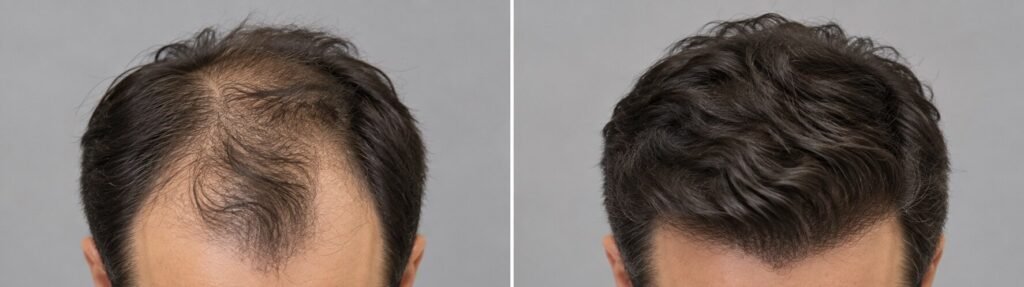
Natural-looking scarring. The tiny circular extraction points in the donor area become invisible at normal hair lengths, meaning the transformation from before to after doesn’t include a visible linear scar signature.
Density comparable to FUT at the same graft count. There is no meaningful density difference in the recipient area between FUE and FUT outcomes for equivalent graft counts in the same patient.
Flexible hairline design. FUE’s single-follicle extraction allows precise sorting of one-hair, two-hair, and three-hair grafts, which enables highly refined hairline design with the finest single-hair units placed in the very front rows.
Before and after documentation. The most reliable way to evaluate what FUE results look like from a specific surgeon is their own patient documentation — consistent clinical photographs at standardized time points. Reputable clinics with thousands of performed procedures have extensive case libraries. Request cases similar to yours — matched by hair type, loss pattern, graft count, and technique.
FUE Hair Transplant Cost: What to Expect in 2026
FUE is generally priced at a 10 to 20 percent premium over FUT at clinics that offer both, due to the longer procedure time required for individual follicle extraction.
United States: Per-graft rates for FUE at US clinics typically run $4 to $10 depending on the practice tier. A standard 2,500-graft FUE procedure costs $8,000 to $18,000 at mid-to-premium US clinics. Motorized FUE (NeoGraft) and robotic FUE (ARTAS) carry additional premiums.
Turkey: All-inclusive FUE packages at accredited Istanbul clinics run €2,500 to €4,000 (~$2,750 to $4,400) covering the procedure, hotel, transfers, medication, and follow-up. Sapphire FUE adds approximately €300 to €600 (~$330 to $660) at clinics that charge separately, though many include it as standard.
UK: FUE at accredited UK clinics typically costs £4,000 to £10,000 depending on graft count and clinic tier.
Cost should be evaluated against surgeon credentials and documented outcomes rather than technique name. NeoGraft and ARTAS premiums are not automatically justified by outcome data.
Who Is a Good Candidate for FUE?
FUE is appropriate for the majority of patients seeking hair restoration surgery, but the best candidates share several characteristics.
Strong donor density. FUE requires extracting individual follicles from the donor area without leaving visible depletion. Patients with dense, healthy donor hair at the back and sides of the scalp have more to work with and produce better results. Very fine or sparse donor hair limits how many grafts can be safely harvested.
Realistic expectations about coverage. FUE can restore significant density but cannot produce the appearance of a full, untouched head of hair for patients with extensive loss. The donor supply is finite. Discussing what’s achievable — and what a second session might provide — is part of a good pre-procedure consultation.
Stable or manageable ongoing loss. Younger patients with active, rapidly progressing loss present a challenge: the hair transplanted today may look natural now but be surrounded by further receding native hair in five years. Good surgeons plan for progression, design hairlines conservatively for younger patients, and often recommend a period of medical management before surgery.
Not a candidate for FUT instead. Patients who need very high graft counts (5,000+), have limited scalp laxity, or have previously had FUT that left significant scarring may be better served by discussing FUT or combination approaches with their surgeon.
Body Hair FUE — using beard or chest hair as donor material when scalp donor supply is insufficient — extends candidacy for patients with limited scalp donor reserves. It requires specific surgeon expertise and typically commands a premium in cost. Results vary by the texture compatibility of the donor hair.
How to Choose the Right FUE Surgeon
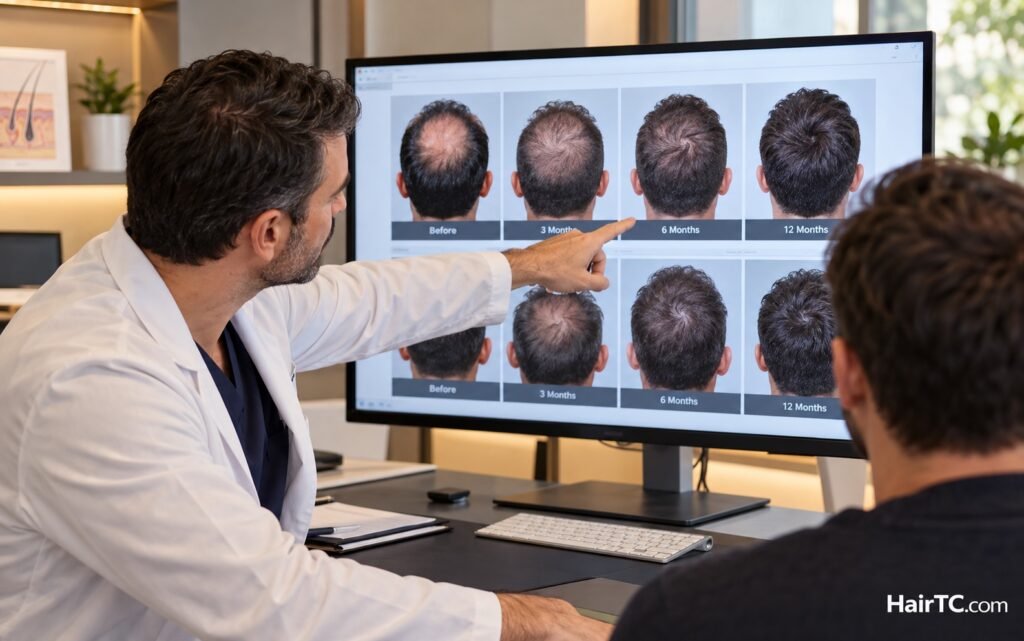
The technique matters less than the surgeon performing it. These are the criteria that distinguish a genuinely skilled FUE practitioner from the rest.
Verify ISHRS membership directly. The International Society of Hair Restoration Surgery is the specialty’s primary professional body. ISHRS membership requires meeting educational and ethical standards. Check ishrs.org directly — don’t accept the clinic’s word for it.
Ask about transection rates. An experienced FUE surgeon should be able to tell you their typical transection rate (the percentage of grafts accidentally damaged during extraction). Anything above 8 to 10 percent represents meaningful graft loss. Inability or unwillingness to answer this question is informative.
Ask who performs each stage. In many operations — particularly high-volume clinics in both Turkey and the US — technicians perform extraction and implantation under physician supervision. Knowing who actually holds the instruments during your procedure is a fundamental question. Get the answer in writing.
Review case documentation at scale. Not the five best results on the home page. A library of cases matched to your profile — your hair type, your loss pattern, your graft count range — that shows consistent results across patients rather than exceptional outliers.
Assess the consultation. A surgeon who spends forty minutes with you, examines your scalp with trichoscopy, discusses your family history, explains the limitations of your donor supply, and addresses your long-term planning is demonstrating the level of attention you’ll receive during the procedure. A twenty-minute consultation that ends with a package quote is a different kind of operation.
Frequently Asked Questions
What is the difference between FUE and FUT hair transplants? FUE extracts individual follicles one at a time using a circular punch tool, leaving tiny circular scars that are invisible at normal hair lengths. FUT removes a strip of scalp from the donor area and dissects it into individual grafts, leaving a single linear scar. FUE is now the dominant technique globally due to its superior scar profile and faster recovery. FUT may yield a higher graft count per session and is still appropriate for specific cases, particularly those requiring very high graft counts.
What is Sapphire FUE and is it better than standard FUE? Sapphire FUE uses sapphire-tipped blades rather than steel for the recipient channel-opening stage. The genuine advantage is slightly smaller, more precise incisions, faster healing, and marginally less tissue trauma. It does not dramatically change final outcomes versus skilled standard FUE, but it is a worthwhile upgrade when offered at minimal additional cost. Surgeon skill matters more than blade material.
How painful is FUE? The local anesthesia injections are the most uncomfortable part — a series of small stings before the area becomes numb. Once anesthesia is in effect, patients feel pressure and vibration during extraction but no pain. Most patients describe the experience as uncomfortable but manageable. Oral sedation or anti-anxiety medication is available at many clinics for patients who want it.
How long does a FUE procedure take? A 2,000-graft procedure typically takes six to eight hours. A 3,000-graft procedure runs eight to twelve hours. Very large sessions of 4,000 to 5,000 grafts may be split across two consecutive days. Total time varies by surgeon pace, technique, and how efficiently extraction and implantation are organized.
What is the recovery time for FUE? Social recovery — being comfortable going out in public — typically takes two to three weeks as scabs resolve. Return to desk work is usually possible within three to five days. Full physical activity clearance, including exercise and swimming, typically takes four to six weeks. Final biological result takes eighteen months.
Is no shave FUE better than regular FUE? Not in terms of outcomes — the results are comparable. No Shave FUE is better for patients who specifically need to avoid the visible post-procedure appearance of a shaved scalp. It takes longer, costs more, and limits graft counts per session. For most patients requiring significant coverage, standard FUE offers better value.
Is NeoGraft better than manual FUE? NeoGraft is a motorized FUE tool, not a superior technique. It assists the extraction process and can reduce procedure time for large graft counts. Clinical outcomes are comparable to skilled manual FUE. It does not justify a dramatic price premium and should not be the primary reason for choosing a clinic.
How many grafts can be taken with FUE? Most experienced FUE surgeons can safely extract 3,000 to 4,000 grafts per session without significantly depleting the donor area. Higher counts — 4,000 to 6,000 — are sometimes possible across two-day sessions at clinics with deep surgeon expertise. Going beyond sustainable donor extraction limits causes permanent thinning of the back and sides of the scalp, which cannot be corrected.
Does FUE leave scars? Yes, but they are tiny circular scars — 0.6mm to 1.0mm — that are invisible at normal hair lengths. At very short or shaved scalp, they appear as small white dots distributed across the donor area. This is the primary advantage of FUE over FUT, which leaves a linear scar that may be visible at shorter lengths.
When does hair grow back after FUE? The transplanted hair shafts shed within two to six weeks post-procedure as the follicles enter a resting phase. New growth typically emerges from month three to five, with visible results from month six and near-final density at months nine to twelve. Full maturation and final density are assessed at eighteen months.
Technical information in this article is based on published clinical literature and documented surgical practice as of early 2026. Individual results vary based on donor characteristics, graft count, surgeon skill, and post-operative care. Always consult with a qualified hair restoration surgeon before making treatment decisions. hairtc.com is an independent editorial resource and does not accept payment from clinics for coverage.