
FUE, FUT, and DHI are the three main hair transplant techniques used in 2026. Clinics market them as if each one is a different result, but the truth is more boring and more useful: they’re variations of the same underlying procedure, with different trade-offs on scarring, recovery, graft survival, and cost. The right one for you depends mostly on how short you want to wear your hair, how many grafts you need, and what your surgeon is best at.
This guide explains the difference between fue vs dhi vs fut hair transplant. Here’s how each technique actually works, what it costs, where it wins, where it doesn’t, and how to choose between them honestly.
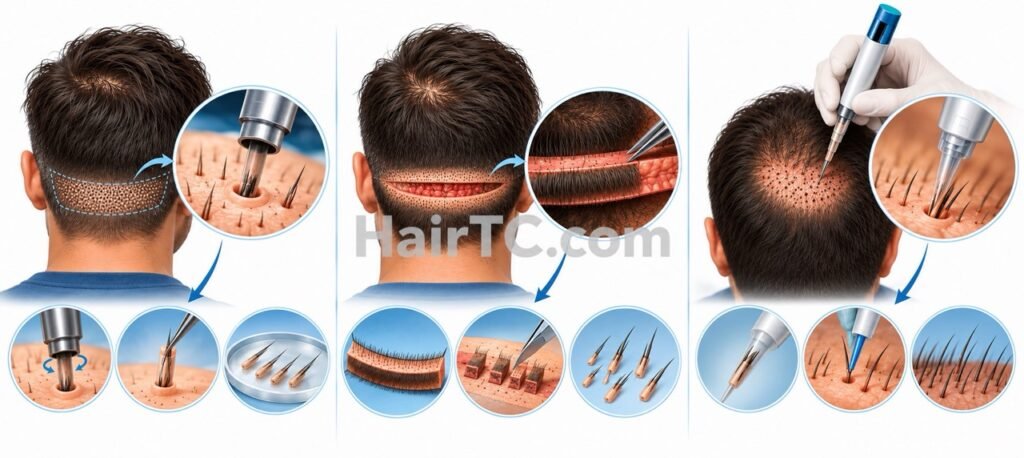
Difference Between FUE DHI and FUT
FUE (Follicular Unit Extraction): individual follicles extracted with small punches. Most common technique worldwide in 2026. No linear scar, recovery in 7 to 14 days, costs $5 to $9 per graft in the US, €1.20 to €1.80 in Turkey.
FUT (Follicular Unit Transplantation): a strip of scalp removed and dissected into grafts. Older technique, still useful for very high graft counts in one session. Leaves a thin linear scar, recovery in 10 to 21 days, costs $4 to $7 per graft in the US.
DHI (Direct Hair Implantation): a variation of FUE using a Choi implanter pen that places grafts directly without pre-made channels. Same scarring as FUE. Marketed heavily, but the clinical advantage is modest. Costs $7 to $11 per graft in the US, €1.80 to €2.50 in Turkey.
The surgeon’s skill matters more than the technique name. A skilled surgeon with FUE produces a better result than an average surgeon with DHI.
How Each Technique Actually Works
FUE: extraction punch by punch
In FUE, the surgeon (or technicians) uses a small circular punch (typically 0.7 to 1.0 mm diameter) to extract individual follicular units from the donor area one at a time. Each unit contains 1 to 4 hair follicles that grow naturally together.
After extraction, recipient sites are created in the bald area using small needles or blades that puncture the scalp at the angle and density planned by the surgeon. Then technicians (or the surgeon) place each follicular unit into the prepared channel.
Key characteristics:
- No linear scar; only thousands of small dot scars across the donor area
- Donor hair must be shaved (or at least short-trimmed) for extraction visibility
- Procedure time: 6 to 10 hours for 3,000 grafts; 10 to 14 hours for 5,000 grafts
- Recovery: surface healing in 7 to 14 days
- Most modern clinics worldwide use FUE as their primary technique
FUT: the strip method
In FUT, the surgeon removes a single strip of scalp from the donor area (typically 1 to 1.5 cm wide and 10 to 22 cm long depending on graft count). The strip is then dissected under a microscope into individual follicular units. The donor area is closed with sutures, leaving a linear scar.
The recipient site creation and implantation phases are the same as FUE.
Key characteristics:
- Linear scar across the back of the donor area, 1 to 2 mm wide when well-closed
- Donor hair doesn’t need to be shaved; only the strip area requires shaving
- Procedure time: 6 to 9 hours for 3,000 grafts; 9 to 12 hours for 5,000 grafts (faster than FUE on the extraction side)
- Recovery: surface healing in 10 to 21 days, longer due to stitches
- Less common in 2026 but still chosen for very large cases or specific situations
For the full picture on FUT specifically, see the FUT guide.
DHI: implant directly with a pen
In DHI, the extraction phase is identical to FUE (small punches, individual follicular units). The difference is the implantation phase. Instead of creating recipient sites first and placing grafts into them afterward, DHI uses a Choi pen (or similar implanter device) that simultaneously creates the channel AND places the graft in one motion.
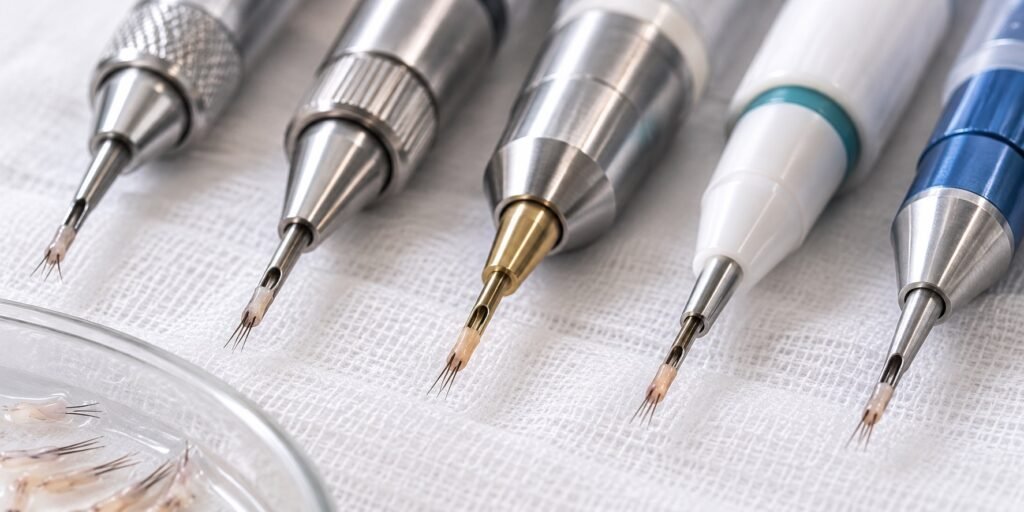
The Choi pen is a hollow device that loads a single graft, punctures the scalp at the desired angle and depth, and releases the graft into the channel as the pen is withdrawn.
Key characteristics:
- Same scarring as FUE (dot scars in the donor area)
- Theoretically allows higher density placement (more grafts per cm²) due to precise channel-and-implant timing
- Allows “no-shave” or limited-shave techniques in some cases since the recipient area doesn’t need pre-made channels
- More labor-intensive (the Choi pens have to be loaded one graft at a time, often by hand)
- Procedure time: similar to FUE, sometimes slightly longer
- Recovery: same as FUE
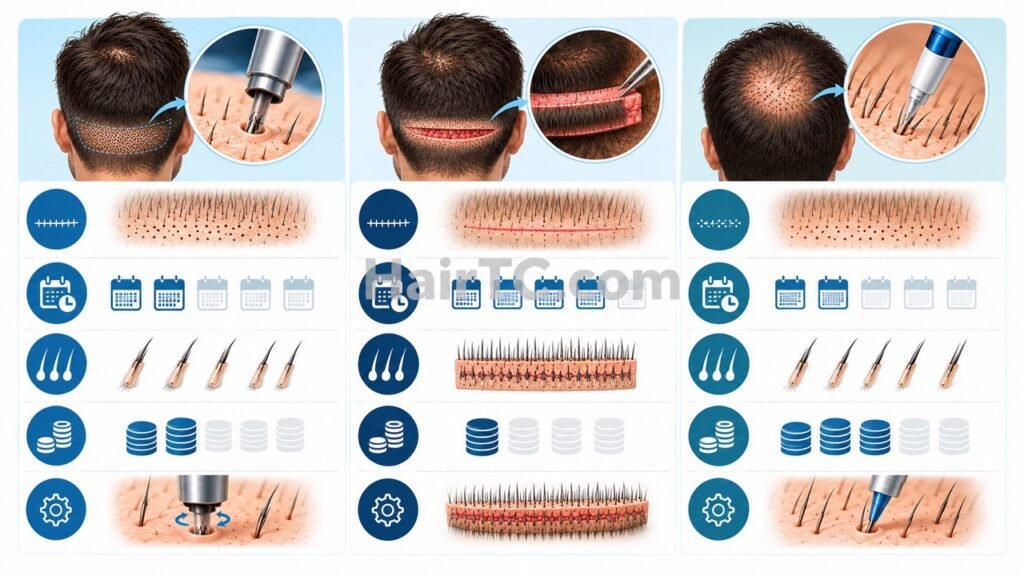
Cost Comparison
The cost difference between techniques is real but smaller than clinics make it sound.
US pricing
| Graft count | FUT | FUE | DHI |
|---|---|---|---|
| 1,500 grafts | $6,000–$10,500 | $7,500–$13,500 | $10,500–$16,500 |
| 2,500 grafts | $10,000–$17,500 | $12,500–$22,500 | $17,500–$27,500 |
| 3,500 grafts | $14,000–$24,500 | $17,500–$31,500 | $24,500–$38,500 |
| 5,000 grafts | $20,000–$35,000 | $25,000–$45,000 | $35,000–$55,000 |
Turkey pricing (all-inclusive packages at top Istanbul clinics)
| Graft count | FUT | FUE | DHI |
|---|---|---|---|
| 2,500 grafts | €2,200–€3,200 | €2,800–€4,000 | €3,500–€5,000 |
| 3,500 grafts | €2,800–€4,000 | €3,200–€4,500 | €4,000–€5,800 |
| 5,000 grafts | €3,500–€5,000 | €4,500–€6,500 | €5,500–€7,500 |
For the broader cost picture, see how much does a hair transplant cost.
Where Each Technique Wins
FUE wins for:
Patients who keep hair short. The dot scarring is concealable at very short lengths (especially with SMP), while FUT’s linear scar is visible at buzz cuts.
Most general cases (1,500 to 4,000 grafts). FUE is the standard for the vast majority of modern transplants and has the strongest body of recent outcome data.
Smaller cases or hairline-only work. Less invasive donor side, faster recovery.
Patients prone to scar widening. The risk of donor area stretching that affects FUT doesn’t apply to FUE.
FUT wins for:
Very large cases (5,000+ grafts) at lower cost. A strip can yield 5,000 grafts more efficiently than punch-by-punch extraction.
Patients with extensive previous FUE. If the FUE donor area is already partially harvested, a strip from a previously unused zone can extract more grafts than additional FUE punches across thinned areas.
Patients who wear medium-to-long hair always. The linear scar is invisible under hair of any normal length.
Surgeons with deep FUT specialization. A surgeon who has done 1,000+ FUT cases will produce better FUT results than they would with FUE, even if FUT is “the older technique.”
DHI wins for:
Women’s hair transplants with limited shaving. The Choi pen allows implantation through existing hair more cleanly than standard FUE.
Cases requiring very dense packing. The simultaneous channel-and-implant minimizes the time a graft is out of the body and allows tighter density placement.
Eyebrow transplants and other fine work. The precision of the Choi pen suits small, detail-heavy cases.
Patients who want a “no-shave” or partial-shave option. Some clinics offer no-shave DHI for the recipient area.
DHI’s clinical advantage over standard FUE on a typical full hairline case is modest. The marketing emphasis on DHI as a “superior technique” generally overstates the real-world difference. Where it matters most is in specific use cases (women, fine work, no-shave) rather than as a general upgrade.
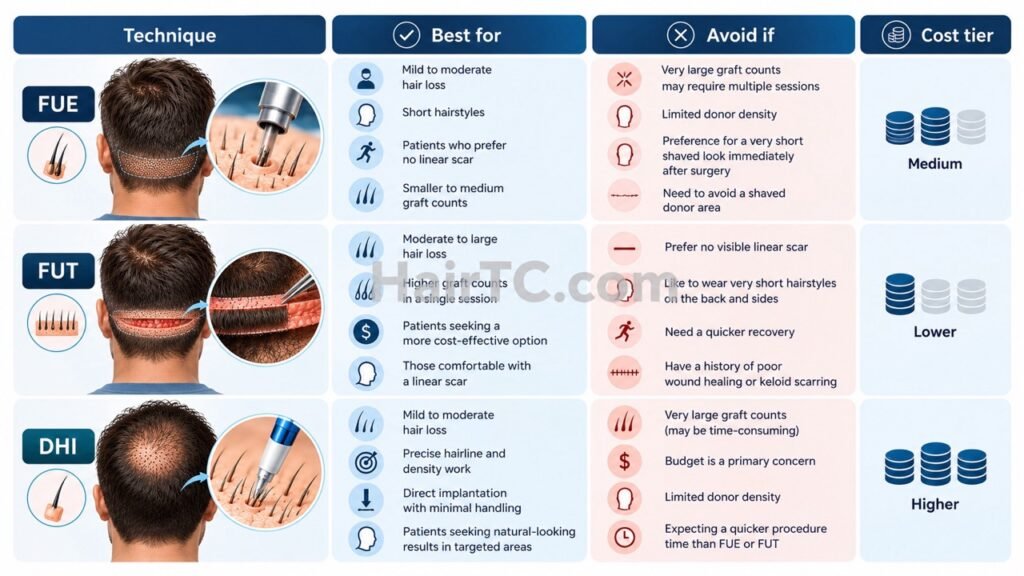
The marketing claims that don’t hold up
A few specific marketing claims around technique selection are weaker than they sound:
“DHI gives better density.” Sometimes, marginally. The biggest density driver is surgeon planning, not the implanter device. A skilled FUE surgeon achieves the same density that a DHI clinic markets, with the same hair characteristics.
“FUE leaves no scar.” False. FUE leaves dot scars across the donor area. At normal hair length, they’re invisible; at shaved length, they’re visible. Clinics marketing FUE as “scarless” are misleading.
“Sapphire FUE is superior to regular FUE.” The sapphire blades affect the channel creation step. The clinical outcome difference between sapphire and steel blade FUE in skilled hands is real but small. It doesn’t justify large price premiums.
“Robotic FUE is the most advanced technique.” Robotic FUE (ARTAS, NeoGraft) automates extraction. It reduces surgeon fatigue and standardizes punch depth. It doesn’t change implantation, hairline design, or planning, which is where most outcome quality comes from. Robotic isn’t worse; it’s just not dramatically better than skilled manual FUE.
“This technique has 99% graft survival.” Specific survival rates are difficult to measure precisely and rarely independently verified. A clinic claiming 99% should be able to show the methodology. Most can’t.
“FUT is outdated and inferior.” FUT remains the right technique for specific cases. A surgeon who refuses to discuss FUT options is missing certain use cases. Some of the most experienced surgeons in the world still perform FUT regularly.
How to Choose the Right Technique for Your Case
Five questions answer it for most patients:
1. How short do you wear your hair?
If you regularly buzz your head to a #1 or shorter, FUE plus SMP is the best path. FUT’s linear scar is visible at very short lengths.
If you wear your hair at #2 or longer, both FUE and FUT are essentially invisible. The scar question matters less.
2. How many grafts do you need?
For 1,500 to 3,500 grafts, FUE or DHI is typically the right choice.
For 4,000 to 6,000 grafts, FUE or FUT both work, with FUT having a slight cost advantage at high counts.
For 6,500+ grafts (split across sessions), the donor strategy matters more than the technique label.
3. What’s your surgeon best at?
Some surgeons are excellent at FUE and weaker at FUT. Some specialize in DHI. Pick the technique your surgeon has the strongest track record with, not the one the clinic markets the hardest.
4. What’s your budget tolerance?
DHI costs 20 to 40 percent more than standard FUE for marginal outcome difference in most cases. If budget is a constraint, FUE delivers nearly the same result for less.
5. Are you a special case?
Women: DHI’s no-shave option matters. Eyebrow work: DHI’s precision matters. Previous FUT or FUE patients with depleted donors: the technique strategy needs case-by-case planning.
The non-technique factors that matter more
Several things affect your result more than the FUE/FUT/DHI choice:
Hairline design. The surgeon’s aesthetic judgment about where to place the new hairline and at what angle. This is independent of technique and is decided in the design phase.
Surgeon vs technician involvement. A surgeon-led case where the doctor performs critical steps personally produces different outcomes than a technician-led case at the same graft count, regardless of technique.
Graft handling time. How long follicles are out of the body affects survival. Top clinics minimize this; weaker teams take longer.
Donor preservation discipline. Whether the surgeon harvests from the safe zone only, with appropriate caps based on your specific donor density.
Post-op care quality. Aftercare protocols, follow-up at 3/6/12 months, touch-up policies. These vary widely between clinics.
A patient who picks “DHI from the cheapest clinic” often gets a worse result than a patient who picks “FUE from the most disciplined surgeon they can afford.”
Scarring: the Honest Comparison
| Technique | Scar type | Visible at short hair | Visible at long hair |
|---|---|---|---|
| FUE | Hundreds to thousands of small dot scars | Slightly visible (more with darker hair/lighter skin) | Invisible |
| FUT | Single linear scar (10-22 cm) | Visible as a thin pale line | Invisible at 1.5cm+ |
| DHI | Same as FUE (dot scars) | Same as FUE | Same as FUE |
Scalp micropigmentation (SMP) can dramatically reduce visibility of either type of scarring. For more on this, see the scars guide.
Recovery Timeline Comparison
| Technique | Surface healing | Return to desk work | Return to gym |
|---|---|---|---|
| FUE | 7-14 days | Day 4-5 | Week 3-4 |
| FUT | 10-21 days | Day 5-7 | Week 4-6 |
| DHI | 7-14 days | Day 4-5 | Week 3-4 |
FUT recovery is slightly longer due to the strip closure. FUE and DHI are nearly identical recovery-wise.
Pain Comparison
All three techniques use local anesthesia. The procedures themselves are not painful. The numbing injections are equally uncomfortable across all techniques (5 to 10 minutes of brief sting).
Recovery pain: FUE and DHI are similar (mild). FUT donor area has a tighter, more pulling sensation for the first 2 to 3 weeks due to the closure.
For the full pain breakdown, see does a hair transplant hurt.
What to do next
If you want a personalized recommendation on which technique fits your case, the graft calculator gives you a graft estimate that helps narrow the technique choice based on case size and goals.
If you want to compare clinics on their primary technique, surgeon experience with each method, and outcome documentation, the clinic finder filters by region and surgical approach.
The right technique for you is the one your specific surgeon executes best, on your specific case, given your hair, donor, and lifestyle. Marketing emphasis on one technique over another rarely tells you what you actually need to know. Focus on the surgeon first; the technique is the secondary decision
Frequently Asked Questions
Which technique is best for women? DHI is often preferred for female cases because the no-shave option allows existing hair to be kept. FUE also works. FUT is rarely the first choice for women because of donor area concerns.
Which technique has the highest graft survival? All three can achieve 90 to 95 percent survival in skilled hands. The surgeon and the graft handling discipline matter more than the technique label.
Is robotic FUE better than manual FUE? Different, not necessarily better. The robot standardizes punch depth and reduces surgeon fatigue. Outcomes in skilled manual hands are equivalent.
Why is DHI more expensive? The Choi pens are slower per graft than standard implantation methods, requiring more technician time. The price difference reflects labor, not material superiority.
Can I combine techniques? Some surgeons use FUT for the bulk of a large case and FUE for the hairline. Hybrid approaches are uncommon but exist for specific case types.
Which technique is least invasive? FUE and DHI are equally non-invasive on the surgical side. FUT is more invasive due to the strip removal and closure.
Which technique is best for a buzz cut lifestyle? FUE or DHI with SMP for scar camouflage. FUT requires longer hair to hide the linear scar.
Is sapphire FUE a separate technique? No. Sapphire FUE is standard FUE using sapphire-tipped blades for the channel creation step. It’s a variation of FUE, not a separate technique. The clinical difference is modest.
Can I get FUE today and FUT later? Yes. Many patients have multiple sessions across techniques. The donor strategy needs careful planning to avoid depleting any one area.
Which technique do top US surgeons use? Most top US surgeons use FUE as their primary technique in 2026, with FUT available for specific cases. Some specialize in DHI.