
The Norwood Scale is the standard way to measure male pattern baldness. It sorts hair loss into seven stages, from no visible loss at Stage 1 to only a thin band of hair around the sides at Stage 7. Doctors and hair transplant surgeons use it to describe how far hair loss has gone, choose a treatment, and estimate how many grafts a transplant may need.
This guide shows what each stage looks like, which treatments fit each one, and when a hair transplant is realistic. Use it to find your stage, then check your numbers with our Graft Calculator.
The 7 stages at a glance
| Stage | What you see | Estimated grafts for a transplant | Common next step |
|---|---|---|---|
| 1 | No visible loss | None | Monitor, healthy habits |
| 2 | Slight temple recession, mature hairline | 500 to 1,200 | Medication, early consult |
| 3 | Deeper temple recession, M or U shape | 1,200 to 1,800 | Medication, transplant |
| 3 Vertex | Hairline holds, crown thinning | 1,800 to 2,500 | Medication, transplant |
| 4 | Larger temple loss plus crown loss | 2,500 to 3,500 | Transplant plus medication |
| 5 | Bald areas widen, hair band narrows | 3,000 to 4,500 | Transplant, may need planning |
| 6 | Front and crown areas join | 4,500 to 6,000 | Transplant limited by donor supply |
| 7 | Only a band at sides and back | 5,500 to 7,000 | Limited transplant, or scalp micropigmentation |
Graft numbers are estimates based on stage alone. Your surgeon sets the final count after checking your donor area, hair type, and density goals.
What is the Norwood Scale?

The Norwood Scale, also called the Hamilton-Norwood Scale, is a seven stage chart of male pattern baldness, also known as androgenetic alopecia. Dr. James Hamilton first described the typical patterns of balding in the 1950s. Dr. O’Tar Norwood revised the system in 1975, and that version is the one used in clinics today.
Male pattern hair loss is driven by genetics and a hormone called DHT, which gradually shrinks hair follicles in the hairline, temples, and crown. This shrinking is called miniaturization. The hairs grow thinner and shorter until they stop growing. The follicles at the back and sides of the head resist DHT, which is why that area is used as the donor area in a transplant.
How to find your Norwood stage
You can get a good first estimate at home in five minutes.
- Take photos in the same bright, even light: one from the front, one from above, one from each side, and one from the back.
- Use dry hair and pull it back from your forehead.
- Compare your hairline and crown with the stage descriptions below.
- Repeat every three to six months to see whether you are progressing.

A photo check is only a starting point. A doctor or hair transplant surgeon can confirm your stage and tell you if something other than male pattern baldness is involved.
The 7 Norwood stages explained
Norwood Stage 1: no visible hair loss
The hairline sits in its youthful position and there is no noticeable recession. Stage 1 is not considered balding. The goal here is prevention: a balanced diet, managing stress, and not ignoring early shedding if baldness runs in your family.
Norwood Stage 2: the mature hairline
The hairline starts to recede at the temples, often forming a small triangle or early M shape. Many men see this in their twenties, and it can be normal. It is still the best time to act, because medication works best on hair you still have. A Norwood 2 hair transplant is possible for some men, but surgeons often suggest waiting to see how fast the loss progresses.
Norwood Stage 3: first clear balding
The temples are deeply recessed in an M, U, or V shape, and those areas are bare or thinly covered. This is the first stage that doctors call clinically significant balding. A Norwood 3 hair transplant is a common choice and usually needs about 1,200 to 1,800 grafts to rebuild the frontal hairline and temples.
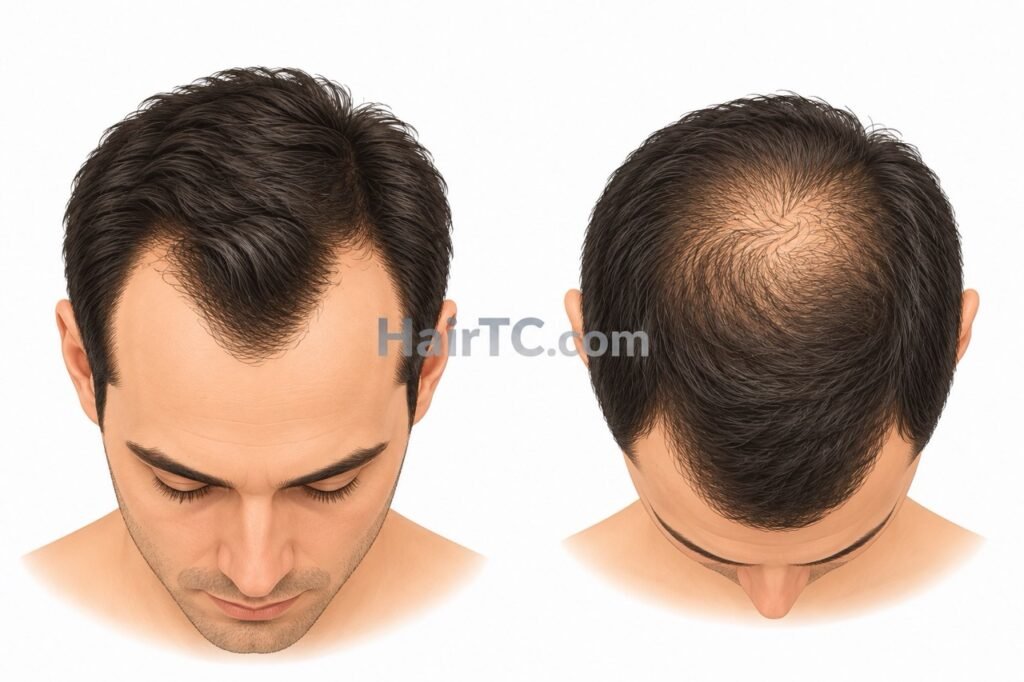
Norwood Stage 3 Vertex: crown loss first
The front hairline stays near the Stage 2 position, but the crown (vertex) thins noticeably. Crown loss is harder to cover than the front because hair there grows in a swirl pattern, so it can take more grafts than you expect. Medication is usually paired with a transplant to protect the hair around the treated area.
Norwood Stage 4: bigger gaps, a hair bridge remains
The temples recede further and the crown is sparse or bald. A band of hair, often called the bridge, still separates the two areas and connects to the hair at the sides. A Norwood 4 hair transplant often needs 2,500 to 3,500 grafts and works best when the surgeon plans for future loss.
Norwood Stage 5: the bridge thins
The front and crown bald areas get larger, and the bridge between them becomes narrow and sparse. Transplants can still give good results, but the surgeon has to balance coverage against donor supply. Some patients need more than one session.
Norwood Stage 6: the areas join
The bridge disappears, and the front and crown merge into one large bald area. Hair remains at the sides and back. A Norwood 6 hair transplant is possible, but the donor area may not cover everything, so the aim is a natural-looking result in the most visible zones rather than full density everywhere.
Norwood Stage 7: the horseshoe
Only a thin band of hair remains around the sides and back. Can a Norwood 7 get a hair transplant? Sometimes, if the donor hair is strong and dense. Results are limited by supply, so surgeons usually focus on the hairline and front third. Scalp micropigmentation is another option for creating the look of shaved short hair.
Norwood Class A: a less common variant
In a smaller group of men, the hairline recedes evenly from front to back without a separate crown bald spot. This is called the Class A pattern. It is staged separately because the loss moves in a straight line instead of the usual M shape.

Norwood Scale and hair transplants: what to know
For most men, a hair transplant works best between Stage 2 and Stage 4. At these stages there is plenty of donor hair and the bald area is smaller, so each graft goes further. At Stages 5, 6, and 7 a transplant can still help, but the number of grafts you need may be close to or above what your donor area can safely supply.
A transplant moves permanent hair from the back and sides to the thinning areas. It does not stop the hair you already have from thinning, which is why many surgeons recommend continuing medication after surgery.
Before you book a consultation:
- Estimate your graft needs with the Graft Calculator.
- Compare price ranges with the Hair Transplant Cost Estimator.
- Review technique options in our FUE hair transplant guide.
- Browse real results at Hair Transplant Before and After.
- Compare surgeons on our hair transplant clinics directory.
Treatment options by stage
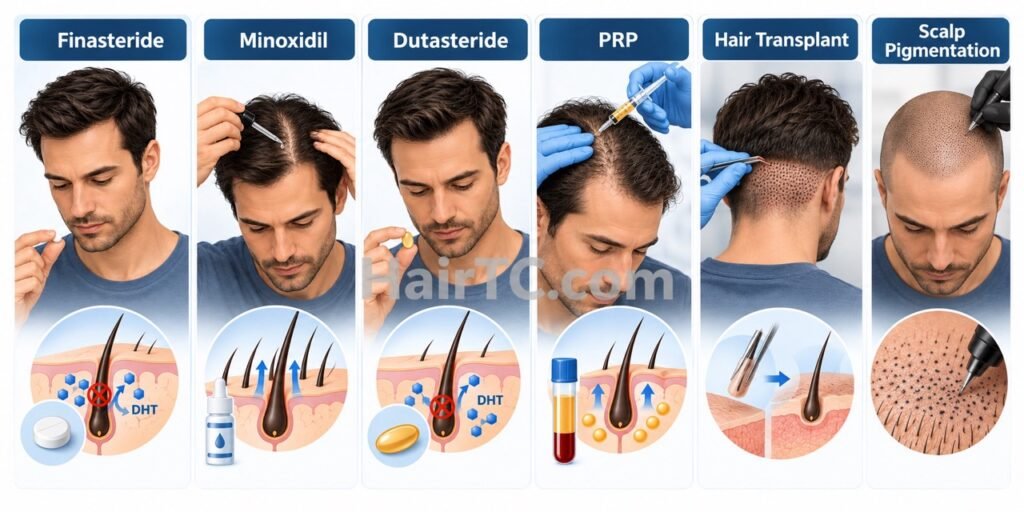
- Finasteride: an oral prescription medication that lowers DHT. Best at slowing loss in Stages 1 to 4.
- Minoxidil: a topical treatment (and sometimes oral under a doctor’s care) that supports growth. Needs steady daily use.
- Dutasteride: a stronger DHT blocker used off-label for hair loss in some countries, only under medical supervision.
- Hair transplant (FUE or FUT): the only option that adds new hair to bald areas. Best for Stages 2 to 5 and selected Stage 6 and 7 cases.
- Scalp micropigmentation: tattooed dots that mimic short hair. Useful at advanced stages or as a complement to a transplant.
- Platelet-rich plasma (PRP): used as a supportive treatment. Evidence is mixed, so treat it as an add-on, not a replacement.
Medication works by protecting existing hair, so starting early gives you more to protect. Always check options and side effects with a doctor first.
What the Norwood Scale cannot tell you
The scale was built for male pattern baldness and has limits. It does not measure hair density, hair thickness, or diffuse thinning across the whole scalp. It also does not apply well to women, who usually follow the Ludwig scale instead.
See a doctor if your hair loss is sudden, patchy, painful, itchy, or comes with scaling or redness. These signs can point to a different condition, such as alopecia areata or a scalp problem, that needs different treatment.
This article is for education only and is not medical advice. Talk with a licensed doctor or hair transplant surgeon about your own diagnosis and treatment.
Frequently Asked Questions
Stage 3 is the first stage most doctors call balding, because the temple recession is deep enough to be clinically significant. Stages 1 and 2 are usually described as no balding or a mature hairline.
Stages 2 to 4 usually give the best balance of donor supply and bald area size. Stage 3 and Stage 4 are the most common reasons men book a transplant. Younger men at Stage 2 are often advised to start medication first and wait.
Sometimes. It depends on how dense and strong the donor hair is. A Norwood 7 hair transplant usually targets the hairline and front third, not the whole scalp, because the donor supply is limited. A surgeon needs to examine you to say what is realistic.
Typical estimates are about 1,200 to 1,800 grafts for Norwood 3, 2,500 to 3,500 for Norwood 4, and 3,000 to 4,500 for Norwood 5. Your own number depends on hair type, density, and donor area. Try our Graft Calculator for a personal estimate.
Norwood 3 Vertex means the front hairline is still around the Stage 2 position, but there is significant thinning at the crown. It is a variation of Stage 3, so it has its own place on the scale.
No. Some men stop at Stage 2 or 3 for years, while others progress faster. Genetics, age of onset, and treatment all play a part. Photos taken every few months show how fast you are moving.
No. Transplanted hair is taken from the back of the scalp and keeps growing for life, but your native hair in the front and crown can keep thinning. Many patients use medication after surgery to protect it.
Not usually. Women more often follow the Ludwig scale, which describes diffuse thinning at the part line and crown instead of a receding hairline.